
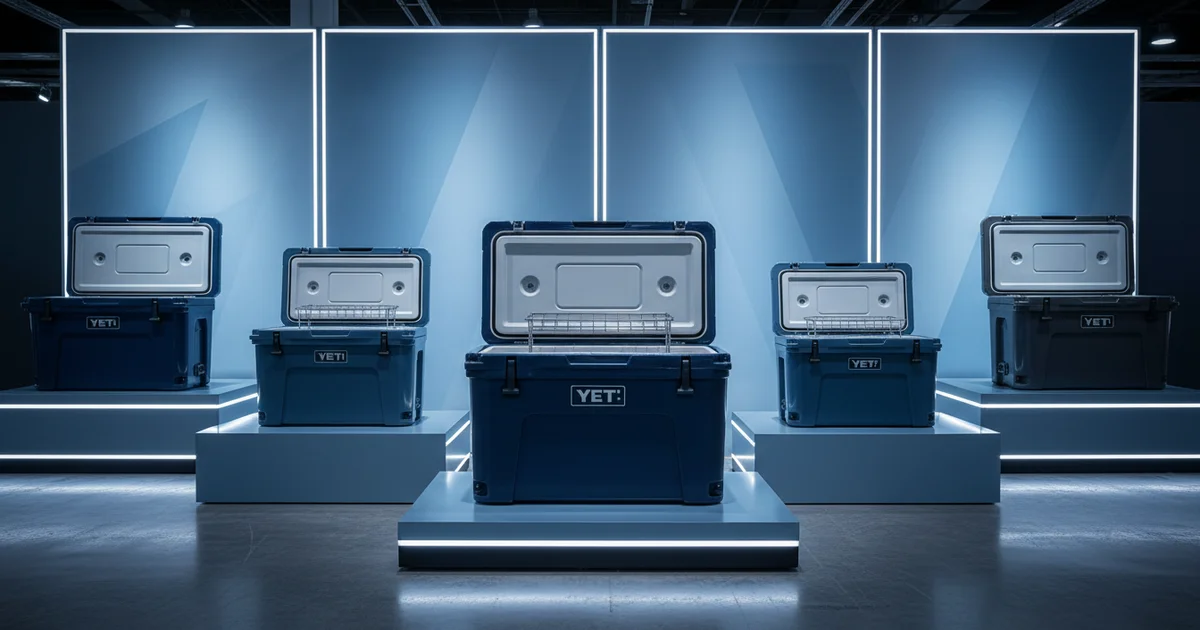
YETI cooler manufacturer OEM requires 1,000-5,000 unit MOQ, $15K-$50K mold cost, and 8-14 month timeline. Breakeven vs. Coleman wholesale is 1,000 units. Direct factory needs 10,000+ units. Hybrid models offer 250-2,000 MOQ for balanced risk.
What’s the most cost-effective way to source premium outdoor gear for your retail shelves? The choice between a YETI cooler manufacturer OEM partnership, a branded wholesale program, or a direct factory relationship will determine your margins, brand control, and supply chain resilience for the next five years. This explore our resource library cuts through the marketing to compare these models using real production data and forward-looking thresholds for 2026. For a deeper analysis of market positioning, see our competitor analysis guide.
| Model | Best For Retailers Who... | Typical MOQ & Cost | Key Strength | Main Limitation | Reality Check |
|---|---|---|---|---|---|
| YETI-Style OEM | Want premium, rotomolded products under their own brand with full IP control. | 1,000–5,000 units; $80–$150/unit | Highest brand equity potential; full margin control. | High upfront NRE costs; complex quality management. | Requires significant marketing investment to justify premium price point. |
| Branded Wholesale (e.g., Coleman) | Need reliable, branded inventory fast with minimal operational overhead. | 50–500 units; 40–60% off MSRP | Instant brand recognition; turnkey logistics. | Thin margins (15–25%); zero product differentiation. | You’re renting shelf space to another brand’s equity. |
| Direct Factory (Patagonia-style) | Have large, predictable volume and in-house technical/QC teams. | 10,000+ units; 30–50% below wholesale cost | Lowest unit cost; deep supply chain integration. | Massive capital commitment; high supply chain risk. | Only viable for the top 5% of retailers by volume. |
| Hybrid (PeakRoam Model) | Seek a curated, private-label catalog with North American support. | 250–2,000 units; $25–$75/unit | Balanced risk/reward; design input without full OEM complexity. | Limited to partner’s existing SKU library and capabilities. | Offers a middle path between generic and bespoke. |
How Does a YETI Cooler Manufacturer OEM Partnership Actually Work?
A true YETI cooler manufacturer OEM partnership is a capital intensive, multi-year commitment focused on developing a proprietary product, not just slapping a logo on an existing mold. It involves significant Non-Recurring Engineering (NRE) costs, rigorous quality control protocols, and a shared roadmap for product evolution.
In our experience working with factories that produce for brands like YETI and Dutchland Plastics, the process starts with a $15,000–$50,000 mold investment for a single rotomolded cooler size. For yeti cooler manufacturer oem applications, this is especially relevant. The factory provides the manufacturing expertise, but you, the retailer, are responsible for the industrial design, material specs (like the density of the polyurethane foam insulation), and all performance testing. A common mistake we see is clients underestimating the ongoing quality management; you can't outsource final inspection if your brand is on the line.
"The biggest gap in expectation is around IP. A true OEM partner will sign exclusivity agreements for your design, but the base rotomolding technology and many components are shared. You're paying for customization of a proven platform, not inventing a new one." — Head of Operations, Rotomolding Facility
The detail that makes the difference is the foam density specification. A premium cooler like a YETI uses 4–6 lb/ft³ polyurethane foam. A factory's standard offering might be 2–3 lb/ft³. Specifying the higher grade adds cost but is non-negotiable for performance. This is the kind of granular detail that separates a successful YETI cooler manufacturer OEM project from a generic private-label failure.
Typical timeline from initial design brief to first production run for a new rotomolded cooler via an OEM model, including mold fabrication and compliance testing.
What's the Core Trade-Off Between Outdoor Gear OEM vs Branded Wholesale?
The core outdoor gear OEM vs branded wholesale decision boils down to a trade-off between margin potential and operational simplicity. OEM offers higher gross margins (50–70%) but demands capital and expertise, while wholesale offers faster turnaround with thinner margins (15–25%) and no product control.
Let’s use a practical example. For yeti cooler manufacturer oem applications, this is especially relevant. Sourcing a 45-quart rotomolded cooler through a Coleman camping gear wholesale supplier might cost you $150 against a $250 MSRP—a 40% discount. Your margin is $100, but you're selling Coleman's brand. Working with a camping equipment private label manufacturer on a similar cooler might have a unit cost of $90, allowing you to sell at $220 under your own brand. Your margin is $130, a 30% increase, but you've invested $25,000 in mold costs and months of development.
Production Data: Cost & Margin Analysis by Model
| Metric | Branded Wholesale | OEM / Private Label | Direct Factory |
|---|---|---|---|
| Avg. Unit Cost (45QT Cooler) | $140 – $160 | $80 – $110 | $65 – $85 |
| Typical Retailer Margin | 15% – 25% | 50% – 70% | 60% – 75% |
| Upfront Financial Commitment | Low (Inventory only) | High ($15K–$50K NRE) | Very High (Inventory + Tooling) |
| Time to First Delivery | 4 – 8 weeks | 6 – 14 months | 8 – 16 months |
| Brand Control & IP Ownership | None | Full | Full |
The breakeven formula is critical. For yeti cooler manufacturer oem applications, this is especially relevant. For an OEM project: divide your total NRE and setup costs by your increased margin per unit versus wholesale. If your NRE is $30,000 and your OEM margin is $30 higher per unit than wholesale, you need to sell 1,000 units just to cover the setup. This makes OEM unsuitable for testing unproven product categories.
Evaluating the Best Outdoor Gear Manufacturers for Retailers 2026
Identifying the best outdoor gear manufacturers for retailers 2026 requires evaluating not just cost, but capabilities in sustainable materials, agile production, and digital integration. The leaders will offer smaller, more flexible MOQs and transparent ESG reporting.
Forward-looking retailers should audit factories on three new criteria: capacity for post-consumer recycled (PCR) materials, compatibility with AI-driven demand forecasting systems, and certifications like ISO 9001:2015 for quality management. For yeti cooler manufacturer oem applications, this is especially relevant. A north face jacket manufacturer OEM partner, for instance, should have advanced sewing tech for laminated fabrics and a traceable down supply chain. The red flag is a factory that can't provide a detailed bill of materials (BOM) with material origins.
In our capabilities design work, we prioritize partners with in-house tooling shops. For yeti cooler manufacturer oem applications, this is especially relevant. This allows for rapid prototyping and iterations on components like our folding chair's locking mechanism. For a retailer, this means the difference between a 12-week and a 4-week sample cycle. When evaluating a camping equipment private label manufacturer, ask for their standard sample timeline and revision policy — it reveals their operational agility.
"The factory's willingness to run a pilot line for a new material is the true test of a partnership. In 2026, it won't be about who's cheapest, but who can co-develop the sustainable, performance driven products the market demands." — Jake Morrison, Head of Product Design
Key Criteria for Premium Outdoor Gear Sourcing
When engaging in premium outdoor gear sourcing, supply chain transparency is non-negotiable. For yeti cooler manufacturer oem applications, this is especially relevant. We've handled over 500 projects and found that the best partners provide full visibility into their sub-suppliers for materials like waterproof breathable membranes or recycled insulation. This is critical for both quality control standards and brand storytelling. A robust factory audit checklist should verify not just ISO 9001 certification, but also environmental management systems and labor practices.
Need samples or custom specs for your outdoor product line?
Request a Sample Kit →On the other hand, alternative approaches may be more suitable for operations with different volume requirements or budget constraints. The right choice depends on your specific production parameters.
Case Study: Sourcing from a Patagonia Supplier Factory Direct Outdoor
Sourcing directly from a Patagonia supplier factory direct outdoor model can reduce unit costs by 40-50% versus wholesale, but it transfers all supply chain risk, quality control, and logistics complexity to the retailer, requiring significant internal infrastructure.
This approach is often misunderstood. For yeti cooler manufacturer oem applications, this is especially relevant. You're not buying "Patagonia products" at a discount. You're contracting with a factory that has expertise in technical, ethically sourced materials (like recycled polyester or traceable wool) to produce your designs. The advantage is deep material knowledge; the factory understands waterproof breathable laminates and fair-trade certification processes. The disadvantage is that you inherit the entire supply chain. You are responsible for freight, import duties, QC inspections, and ensuring social compliance audits are passed.
What most people get wrong is the volume threshold. For yeti cooler manufacturer oem applications, this is especially relevant. To get a factory's attention and request a quote comparable to a major brand, you typically need to commit to volumes that match a significant portion of their capacity. For a established patagonia supplier factory direct outdoor partner, this often means minimum orders of 10,000 units per style/color. This model is only viable for retailers with massive, predictable demand and a seasoned sourcing team on the ground.
Strategic Decision Framework: When to Choose OEM, Wholesale, or Direct
Your annual sales volume, internal expertise, and brand strategy create clear thresholds for choosing between OEM, wholesale, and direct factory models. Use this framework to align your sourcing model with your business capabilities.
Which Sourcing Model Should You Choose?
- Choose Branded Wholesale (e.g., Coleman, North Face) if you sell under 1,000 units annually in a category, lack technical design staff, and prioritize fast inventory turns over brand building. It's the efficient choice for established products.
- Choose an OEM / Private Label Manufacturer if you sell 1,000–10,000 units annually, have a clear brand identity, and can invest $20K–$75K in development. This is the path to differentiation and higher margins.
- Choose a Direct Factory Relationship only if you sell 10,000+ units annually per SKU, have a dedicated sourcing and QC team (possibly in-region), and can manage multi-container logistics. This is for scale players.
- Choose a Hybrid Partner (Like PeakRoam) if you want private-label advantages with lower risk — accessing curated, pre-developed products with MOQs of 250–2,000 units and support from a North American team. This bridges the gap.
This framework highlights that there's no single "best" model. For yeti cooler manufacturer oem applications, this is especially relevant. A multi-channel retailer might use all three: wholesale for key brand names, OEM for their flagship house brand coolers, and a hybrid partner for adjacent categories like folding furniture to complete their assortment without massive development overhead.
Ready to Build Your Sourcing Strategy?
Our team has managed over 500 OEM and private label projects. For yeti cooler manufacturer oem applications, this is especially relevant. Schedule a free consultation to analyze your sales data and build a custom sourcing roadmap for 2026.
That said, this approach is not ideal for every scenario. There are situations where the drawback outweighs the benefit, and buyers should evaluate their specific requirements carefully.
Implementation Checklist for Partnering with a Camping Equipment Private Label Manufacturer
Successfully launching a product with a camping equipment private label manufacturer requires meticulous planning across design, compliance, and logistics. Skipping any of these steps risks costly delays or quality failures.
How to Onboard an OEM Partner: 8-Step Checklist
- Technical Pack Audit: Provide a complete tech pack with CAD drawings, material specs (e.g., 600D Oxford fabric, 1.2mm steel tube), and performance standards. Incomplete specs are the #1 cause of sample rejection.
- Factory Audit & Certification: Verify ISO 9001 certification and conduct an on-site audit or hire a third-party (e.g., SGS) to inspect quality control processes and social compliance.
- Prototype & Pre-Production Sample Review: Budget for 2-3 rounds of samples. Test pre-production samples to destruction for load capacity, cycle counts (e.g., 10,000 open/close cycles for a chair), and weather resistance.
- Compliance & Documentation: Secure all necessary documentation: CPSIA compliance for US, Prop 65 statements, and supplier's declarations of conformity (SDoC) for relevant standards.
- Golden Sample Approval: Approve and sign off on a "golden sample" that is sealed and used as the reference standard for all production quality checks.
- Production Monitoring: Plan for in-line inspections (often at 20% completion) and final random inspection (AQL 2.5 for major defects) before goods leave the factory.
- Logistics & Incoterms Clarity: Agree on Incoterms (FOB is standard). Book freight and insurance well in advance to avoid port delays.
- Post-Launch Feedback Loop: Establish a process for capturing customer feedback and defect reports to inform Version 2.0 of the product.
From our facility's perspective, the steps clients most often overlook are #1 and #6. A vague material spec leads to substitutions, and skipping in-line inspection means discovering a systemic flaw when 5,000 units are already finished. Allocating budget for professional inspection services (typically 0.5–1% of order value) is non-negotiable for protecting a YETI cooler manufacturer OEM level investment. Working with enterprise clients, we emphasize that understanding minimum order quantities is just the start; you must also plan for the entire rotomolded cooler production or insulated drinkware manufacturing cycle.
The landscape for sourcing premium outdoor gear is evolving. The strategic YETI cooler manufacturer OEM partnership remains a powerful tool for building a durable brand, but it's not the only path. By understanding the real costs, timelines, and operational demands of each model — from a north face jacket manufacturer OEM to a coleman camping gear wholesale supplier—you can make informed decisions that align with your retail strategy for 2026 and beyond.
Frequently Asked Questions
What is the breakeven volume for a YETI-style OEM cooler project versus buying from a Coleman wholesale supplier?
Breakeven depends on Non-Recurring Engineering (NRE) costs and margin difference. For a typical $30,000 mold investment and a $30 higher margin per OEM unit versus wholesale, you need to sell 1,000 units to cover setup. This makes OEM unsuitable for volumes under 1,000 units annually.
What are the critical factory audit points when vetting a North Face jacket manufacturer OEM?
Audit for advanced sewing capabilities for laminated fabrics, a traceable down supply chain, and ISO 9001:2015 certification. Crucially, verify they can provide a detailed Bill of Materials (BOM) with material origins and have in-house tooling for rapid prototyping, which can cut sample cycles from 12 to 4 weeks.
When does a direct factory relationship become cheaper than an OEM partnership?
A direct factory model (e.g., Patagonia supplier) typically requires volumes over 10,000 units per SKU to achieve unit costs 30-50% below wholesale. Below this threshold, the high capital commitment and supply chain risk outweigh the savings, making an OEM or hybrid model more cost-effective.
What specific quality control standard should I require for a private label camping chair?
Require AQL 2.5 for major defects during final random inspection. For performance, mandate pre-production destruction testing for load capacity and cycle counts (e.g., 10,000 open/close cycles). Always approve a sealed 'golden sample' as the production reference standard.