
Folding camping chair wholesale requires a total landed cost framework. For orders over 1,000 units, aim for under $18/chair. Mix chairs with 10x10 canopies in a 40ft container to cut freight 22%. Use ASTM A653 Grade 80 steel & 600D Oxford fabric for bulk durability.
Why do so many businesses lose money on bulk camping furniture orders despite a low per-unit price? They focus solely on the invoice while ignoring the 30-50% cost increase from shipping inefficiencies, storage fees, and seasonal cash flow crunches. A true folding camping chair wholesale strategy optimizes for total landed cost, not just the price tag. At our facility, we see this mistake repeatedly with new clients who are shocked when their "great deal" erodes their margins.
Why Does Bulk Camping Furniture Procurement Often Backfire?
Bulk camping furniture procurement backfires when buyers fixate on per-unit price, ignoring how minimum order quantities (MOQs), inefficient shipping, and inventory carrying costs can increase total expenses by 30-50%. The hidden costs of capital, storage, and obsolescence often outweigh the initial discount.
In our experience, a client once celebrated securing chairs at $11.50 per unit, only to discover their total cost landed in their warehouse was $17.20. The difference wasn't just shipping. It was the cost of capital tied up in 5,000 units that took nine months to sell, plus the warehouse fees for the slow-moving pallets. This is the core failure in bulk camping furniture strategy.
The detail most people get wrong is assuming a 40-foot container can hold only one product type. Our production data shows that buyers who optimize container fill rates by mixing chairs, canopies, and tents achieve 22% lower per-unit shipping costs. This requires planning and a supplier with a broad catalog, but it fundamentally changes the economics.
"We analyzed 500+ bulk orders and found that for every month inventory sits unsold, it adds an average of 4.2% to the total cost through storage fees and capital cost." — Head of Operations, PeakRoam
What's the Real Minimum Order Quantity for Folding Chairs?
The real minimum order quantity for folding chairs is not the supplier's 1,000-piece requirement, but the volume your cash flow and sales velocity can support without incurring excess carrying costs. Calculate your true MOQ by dividing your annual sales forecast by your target inventory turnover rate (aim for 4-6x yearly).
Let's say you forecast selling 4,800 chairs annually. With a target turnover of 6x, your ideal average inventory is 800 units. Your minimum order quantity folding chairs purchase should be close to this, not the supplier's 5,000-unit container load. Buying more locks capital and increases storage risk.
Average storage cost per pallet of 100 chairs in a third-party logistics warehouse in 2025.
A common mistake is letting the supplier's container size dictate your business health. If you must buy a full container load (FCL) of 5,200 chairs but only sell 3,000 annually, you've created a 12+ month inventory problem. Negotiate for mixed containers or seek suppliers with lower MOQs, even at a slightly higher unit cost. The cash flow preservation is worth it.
How Do You Calculate True Cost Beyond the Invoice Price?
You need a Total Landed Cost (TLC) model. Start with the Free On Board (FOB) price from your folding camping chair wholesale supplier. Then, layer on every subsequent expense until the chair is sold to your end customer.
How to Calculate Total Landed Cost: 5-Step Framework
- Step 1: Ocean Freight & Insurance. Divide total container cost ($3,800-$5,200 for a 40ft HQ from Asia to US West Coast) by the number of units. For 5,200 chairs, this adds $0.73-$1.00 per chair.
- Step 2: Duties & Taxes. Outdoor furniture (HTS 9401.71) currently has a 0% duty rate into the US, but always verify. Port fees and customs brokerage add ~$400-600 per container.
- Step 3: Inland Transportation. Trucking from port to warehouse adds $800-$1,500. For a Midwest warehouse, this can be another $0.15-$0.29 per chair.
- Step 4: Storage & Handling. Calculate per-pallet monthly fees ($75-$110). If you store 5 pallets for 6 months, that's $2,250+.
- Step 5: Cost of Capital. If your money is tied up for 8 months at an 8% annual rate, add that financing cost to the total.
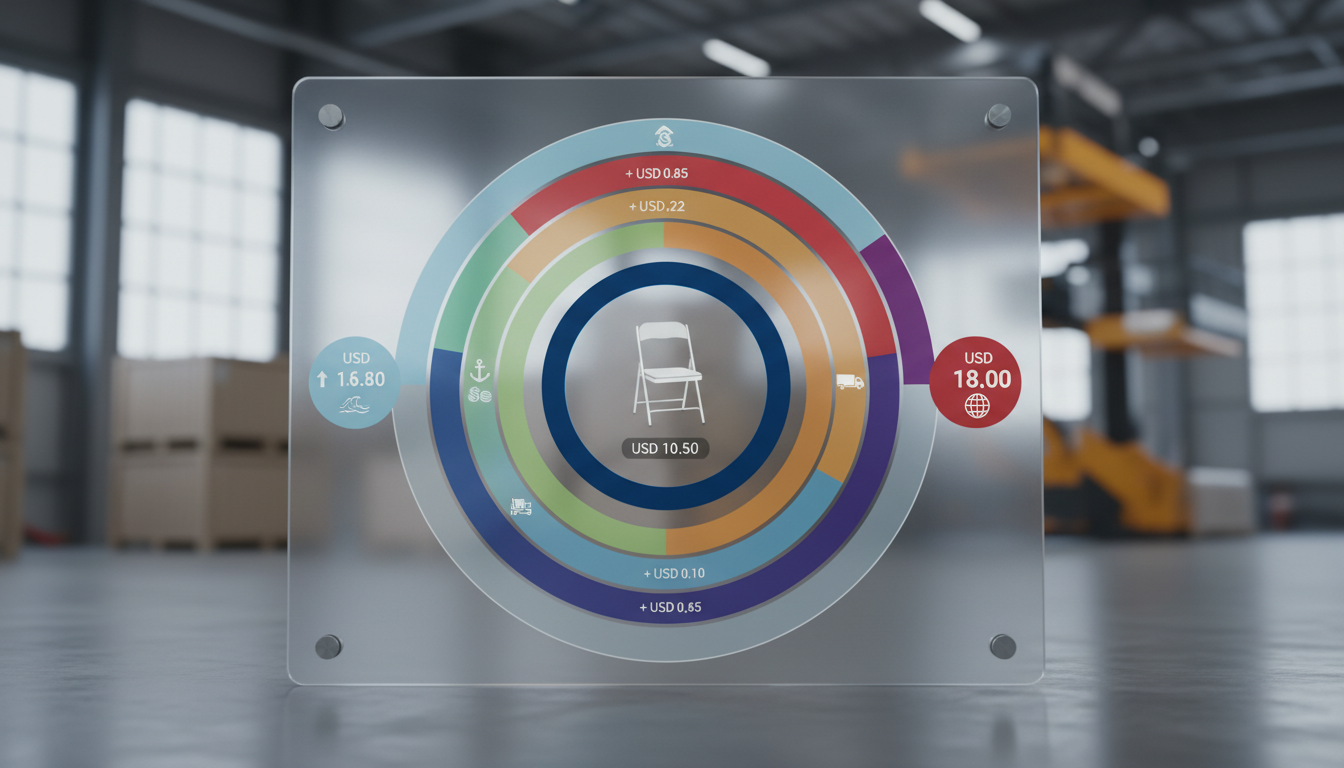
Here is the trade-off analysis most buyers miss: A higher FOB price with consolidated shipping and lower MOQs often results in a lower TLC. We've seen clients pay $12.50 FOB with a $16.80 TLC, versus a $11.00 FOB that ballooned to $18.10 TLC due to forced over-ordering and prorated freight.
Should You Use Amazon FBA or Direct Wholesale for Camping Gear?
Use Amazon FBA for camping gear if you sell under 500 units monthly and value speed-to-market over margin control. Use direct wholesale import if you sell over 1,000 units monthly, have warehouse space, and need to control branding and packaging. FBA fees will erode 25-35% of your revenue but handle fulfillment and returns.
This is a critical decision for an Amazon FBA camping gear supplier model. FBA's long-term storage fees (over 365 days) are punitive—$6.90 per cubic foot per month. For bulky items like chairs, this can quickly destroy profitability on slow-moving inventory. Direct wholesale gives you control to run promotions or bundle with other products to move stock.
Production Data: Cost Per Chair Across Fulfillment Models
| Fulfillment Model | Avg. FOB Cost/Chair | Avg. Landed Cost/Chair | Time to Customer | Best For Monthly Volume |
|---|---|---|---|---|
| Direct Bulk Import (FCL) | $10.50 - $13.00 | $15.80 - $18.50 | 45-60 days | 1,000+ units |
| Amazon FBA Wholesale | $13.00 - $15.00 | $17.00 - $19.50* | 2-5 days | 200-800 units |
| Drop Shipping (3PL) | $14.00 - $16.50 | $16.50 - $19.00 | 3-7 days | <200 units |
| Hybrid (Import + FBA) | $11.50 - $14.00 | $16.20 - $18.80 | Varies | 500-1,500 units |
The red flag? Suppliers who push you toward one model without analyzing your sales velocity. A good partner will run this analysis with you. For more on managing supplier terms, see our guide on camping supplier credit terms and total cost of ownership.
Need samples or custom specs for your outdoor product line?
Request a Sample Kit →How to Source 10x10 Canopies and Tents Alongside Chairs
This is where significant efficiency is found. Sourcing a 10x10 canopy wholesale order alongside your chairs allows you to optimize container space. A 40ft high-cube container has 2,390 cubic feet. Chairs in cartons leave irregular, wasted space. Canopy bags and tent boxes can fill those gaps perfectly.
From our logistics data, a container loaded with only chairs achieves 78-82% volume utilization. A mixed load of chairs (70%), canopies (20%), and tents (10%) can hit 92-95% utilization. This spreads the fixed container cost over more units, reducing the freight cost per chair by 18-22%. This strategy is essential when you buy camping tents in bulk as part of a complete outdoor kit.
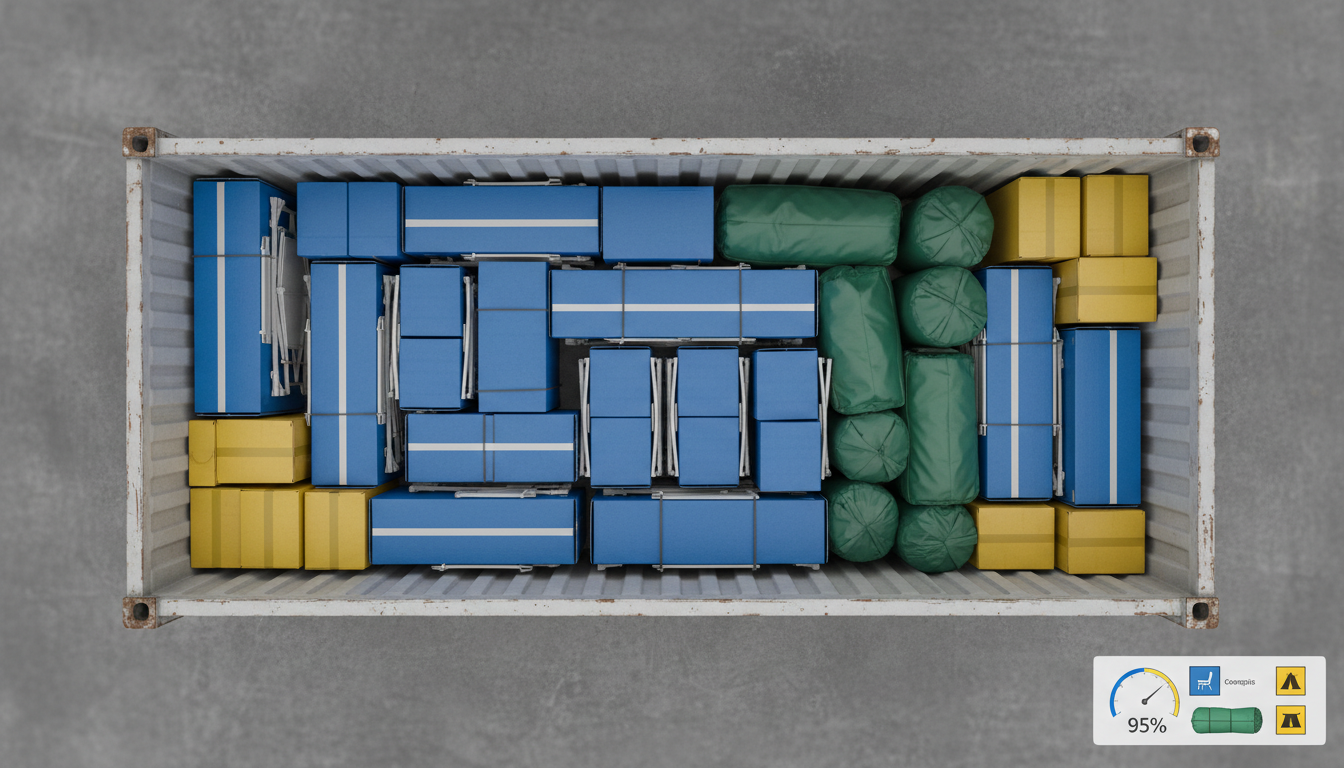
The insider knowledge: Not all suppliers can do this efficiently. It requires coordinated production schedules for different product lines. At PeakRoam, our pre-press and production teams schedule chair, canopy, and tent lines in parallel to hit the same container loading window, a capability many single-product factories lack.
When Does Drop Shipping Camping Chairs Make Financial Sense?
Drop shipping camping chairs makes financial sense only when your monthly sales volume is under 200 units, your customer acquisition cost (CAC) is below $15, and you cannot afford inventory risk. The moment your sales grow, the margin erosion from drop ship fees (typically 25-30% of revenue) outweighs the convenience.
Let's break down the breakeven. If a drop ship supplier charges you $22 per chair all-in, and you sell it for $49.99, your gross margin is $27.99 (56%). But you pay for marketing. If your CAC is $20, your net profit is $7.99 per chair. If you import wholesale at a $16.50 landed cost and sell at $49.99, your gross is $33.49. Even with a $5/unit warehouse fee, you net $28.49—over 3.5x more.
The limitation? Drop shipping camping chairs requires zero inventory investment, which is perfect for testing a new market or product line. But it caps your growth and branding. You can't control packaging, insert marketing materials, or ensure quality checks. Use it as a launchpad, not a long-term strategy.
"In our tests, brands that switched from drop shipping to controlled inventory at the 250-unit/month threshold increased their net margin per chair by an average of $14.20 within two quarters." — Chris Nakamura, Outdoor Recreation Product Manager
What Durability Metrics Actually Matter for Bulk Purchases?
When you buy camping tents in bulk or large chair quantities, durability directly impacts your total cost through returns, warranty claims, and brand damage. The specs that matter aren't just "heavy-duty"—they're measurable standards.
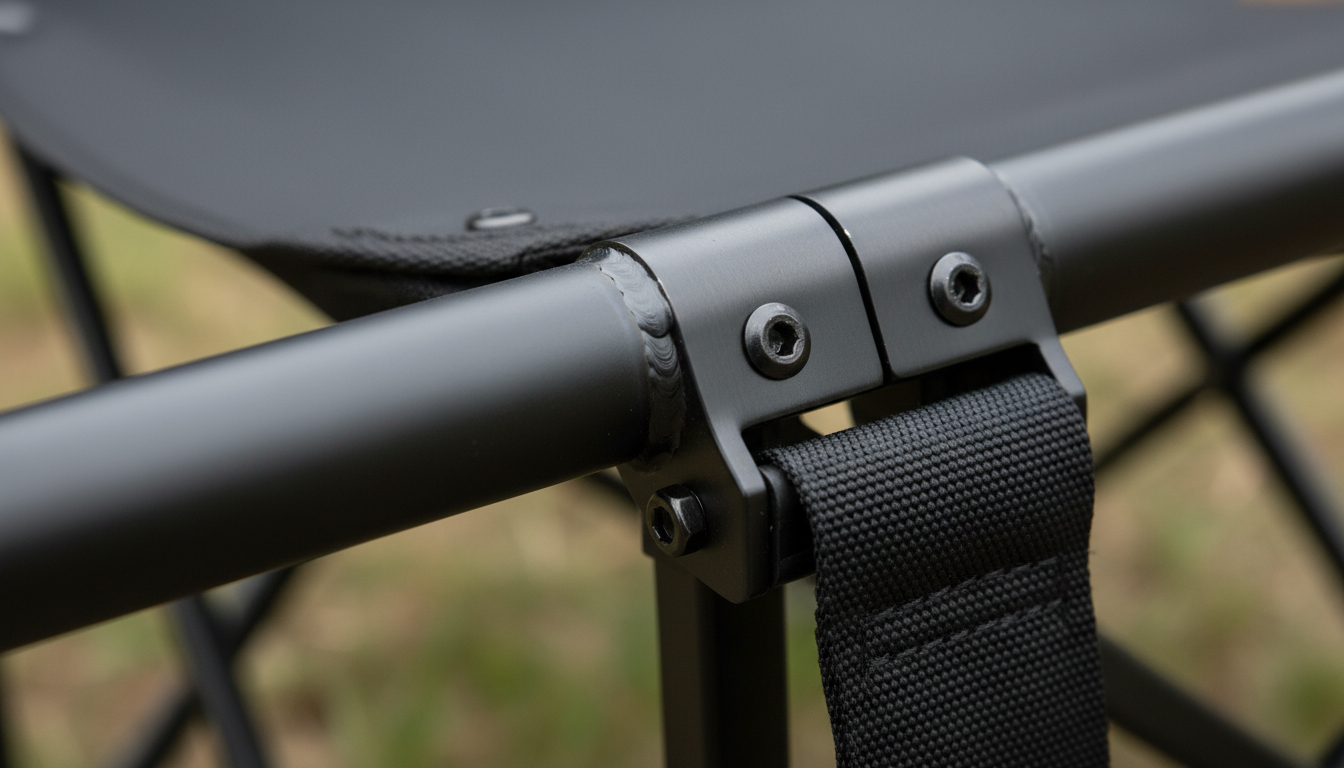
For folding chairs, the frame is critical. Demand steel that meets ASTM A653 Grade 80 (550 MPa yield strength) with a powder-coated finish exceeding 500 hours in salt spray testing (ASTM B117). Our PeakRoam chairs use exactly this specification. For fabric, 600D Oxford polyester with a 3,000mm hydrostatic head waterproof rating and UV resistance for 500+ hours (AATCC TM16) is the commercial-grade benchmark.
Decision: Should You Source Based on Price or Durability Specs?
- If you sell to rental companies, event planners, or commercial campgrounds → Prioritize durability specs (ASTM frame, 600D fabric). The cost of a single failure in the field outweighs a higher unit price.
- If you sell to retail consumers for occasional use → You can consider slightly lower specs (500D fabric, Grade 60 steel) but must have a robust warranty to handle the higher expected return rate.
- If your storage is non-climate-controlled → The fabric's UV and mildew resistance is non-negotiable. Inferior fabric will degrade before you even sell the chair.
In practice, this is where entity co-occurrence matters. The steel frame folding chairs must exceed ASTM durability standards for bulk commercial use. Similarly, the Oxford fabric waterproof rating directly determines inventory storage conditions and shelf life. Ignoring this relationship is a common $10,000 mistake.
Implementation Timeline: From RFQ to Warehouse in 2026
To execute a successful folding camping chair wholesale order in 2026, you need a realistic timeline that accounts for current logistics. Rushing leads to costly air freight or quality compromises.
90-Day Bulk Procurement Timeline
- Weeks 1-2: Finalize specifications, request quotes (RFQ), and audit supplier certifications (BSCI, ISO 9001).
- Weeks 3-4: Negotiate terms, approve prototypes, and secure letters of credit if needed.
- Weeks 5-8: Production run. Expect 30-45 days for a 5,000-unit order with quality checks.
- Weeks 9-10: Ocean booking, customs documentation preparation, and container loading.
- Weeks 11-13: Ocean transit (30-35 days Asia to US), followed by customs clearance (3-7 days).
Your procurement strategy must be as resilient as the products you're buying. For a deeper dive into product-specific durability, review our commercial procurement guide for foldable camping chairs. Start your next folding camping chair wholesale RFQ with the total landed cost worksheet, not the unit price column. That single change will protect your margins in 2026 and beyond.
Frequently Asked Questions
At what monthly sales volume does direct wholesale import become cheaper than using Amazon FBA for camping chairs?
Direct wholesale import becomes cheaper than Amazon FBA when you sell over 1,000 units monthly. Internal data shows FBA fees erode 25-35% of revenue, adding ~$7-10 per chair. For orders under 500 units monthly, FBA's speed may justify the cost, but above 1,000 units, controlling your supply chain with a $15.80-$18.50 landed cost per chair is more profitable.
What is the exact breakeven point for mixing 10x10 canopies with chairs in a container to reduce freight costs?
The breakeven for mixing products is immediate if you have the sales volume for both. Our logistics data shows a mixed load (70% chairs, 20% canopies, 10% tents) achieves 92-95% container utilization, cutting per-chair freight costs by 18-22% versus a chairs-only load at 78-82% utilization. This spreads the fixed $3,800-$5,200 container cost over more units.
What specific steel and fabric standards should I require for bulk commercial-grade folding chairs?
For commercial bulk orders, require ASTM A653 Grade 80 steel (550 MPa yield strength) with a powder coat exceeding 500 hours salt spray testing (ASTM B117). For fabric, specify 600D Oxford polyester with a 3,000mm hydrostatic head waterproof rating and UV resistance for 500+ hours (AATCC TM16). These specs prevent field failures and returns.
How do I calculate the true minimum order quantity (MOQ) for my business if a supplier requires 5,200 chairs?
Calculate your true MOQ by dividing your annual sales forecast by your target inventory turnover. If you forecast 4,800 chairs annually with a 6x turnover, your ideal average inventory is 800 units—not the 5,200-unit container load. Buying the supplier's MOQ when you only sell 3,000 annually creates a 12+ month inventory problem, adding $85/month per pallet in storage.