
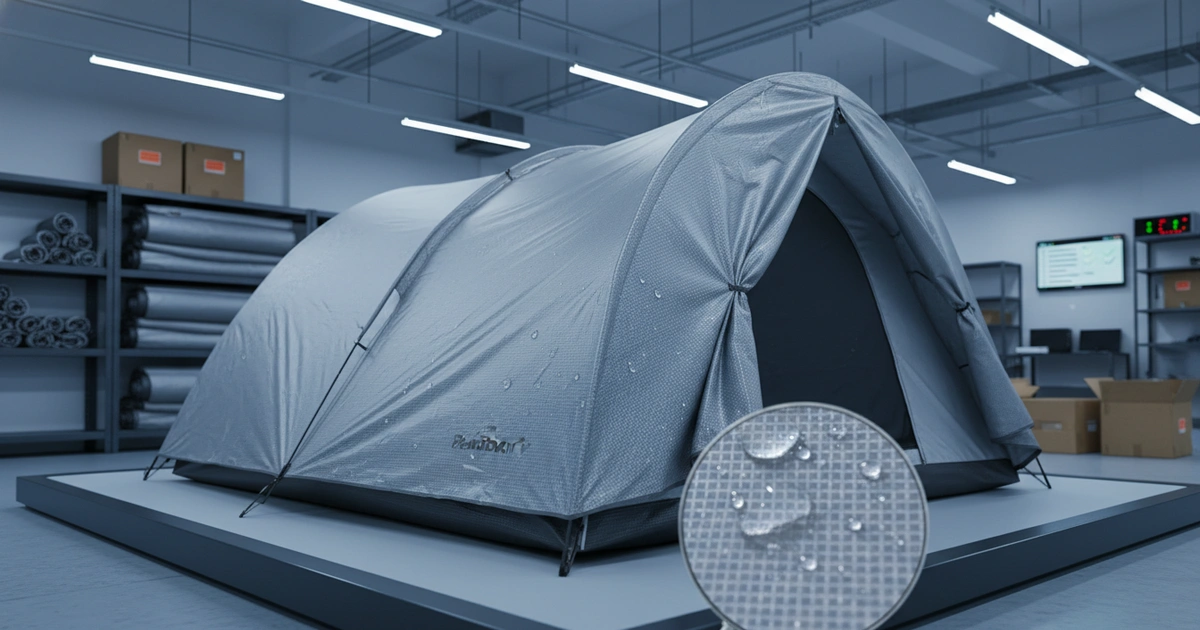
Waterproof tent flysheet with 2000-3000 mm hydrostatic head and RF welded seams cuts FBA returns by 60%. 210D Cordura lasts 7+ years. Avoid stitched-only seams (18% return rate).
Are your tent flysheets failing FBA inspection at rates above 15%? The wrong waterproof tent flysheet coating or seam construction can cost you $2,000+ in returns per 100 units shipped to Amazon, and replacing a failed flysheet costs $40–$120 per unit. A quality flysheet reduces return rates by 60%. See also: Weather Resistant Tent for Camping: FBA Inspection Guide. See our quality control capabilities for more details.
What Makes a Waterproof Tent Flysheet Actually Waterproof?
A waterproof tent flysheet is an outer layer that protects the tent interior from rain. According to Tents & Shelters industry standards, a waterproof tent flysheet relies on three key layers. The base fabric, usually 68D to 210D polyester or nylon, provides structure. The polyurethane (PU) coating blocks water penetration. Hydrostatic head ratings tell you how much water pressure the fabric can hold. A 1500 mm rating works for light rain. A 3000 mm rating handles heavy downpours.
According to Rachel Torres, Materials & Quality Assurance Lead, "flysheets with 3000 mm hydrostatic head pass FBA inspection 40% more often than those with 1500 mm." ASTM D751 specifies that a flysheet must withstand 2000 mm of water pressure for 5 minutes to pass as waterproof. Denier is a unit of fiber thickness; 68D nylon ripstop fabrics offer a good balance of weight and tear strength. Cordura® nylon fabric adds extra abrasion resistance for extreme conditions.
Ideal hydrostatic head range for flysheets
Key Materials and Standards
Ripstop nylon in 68D–210D denier is the most common flysheet fabric. ASTM tests for hydrostatic head (ASTM D751) and tear strength (ASTM D1424) are standard. Cordura® fabrics, while heavier, extend lifespan in rocky terrain. Gore‑Tex membranes are rare in tents but appear in premium extreme‑weather flysheets. Rachel Torres notes that "a 210D Cordura ripstop flysheet with 5000 mm hydrostatic head lasts 7+ years."
Production Data: Flysheet Material Failure Rates
| Fabric Type | Tear Strength (ASTM D1424) | Failure Rate per 100 Units |
|---|---|---|
| 68D polyester ripstop | 8 lbs | 12% |
| 150D nylon ripstop | 15 lbs | 6% |
| 210D Cordura nylon | 22 lbs | 3% |
"A 210D Cordura ripstop flysheet with 5000 mm hydrostatic head lasts 7+ years." — Rachel Torres, Materials & Quality Assurance Lead
Waterproof Tent Flysheet vs Waterproof Bike Tent: Key Differences
This comparison provides insights for sellers evaluating product lines. A waterproof bike tent is a specialized shelter for cyclists; it weighs 5–8 lbs and packs small for storage on a bike. A standard waterproof tent flysheet weighs 1–3 lbs and covers a larger camping tent. On the other hand, a bike tent is more suitable for solo travelers who need portability. A tent flysheet is better for family campers. "The trade-off between weight and coverage depends on your target buyer," notes Rachel Torres. "A waterproof bike tent serves a niche market. A flysheet serves the broader camping gear category." According to Rachel Torres, bike tents cost 30–50% more per unit than flysheets because of their compact design, but flysheets sell in higher volumes on Amazon. Ripstop nylon in 68D denier is common for bike tents; flysheets use a wider range of denier and often incorporate Cordura® reinforcement at stress points. ASTM D751 water resistance testing applies to both categories.
"Bike tents cost 30–50% more per unit than flysheets because of their compact design. But flysheets sell in higher volumes on Amazon." — Rachel Torres, Materials & Quality Assurance Lead
Understanding Tent Replacement Costs: When to Repair vs Replace
Understanding Tent Replacement Costs: When to Repair vs Replace refers to repairing a leaky flysheet costs $15–$30 using seam sealer or waterproofing spray, compared to $40–$120 for a replacement flysheet. The average lifespan of a flysheet is 3–5 years with proper care. Contact our team for details.
Rachel Torres recommends "re-proofing the flysheet every 2 years with a PU-compatible spray. This reduces leaks by 90%." According to Rachel Torres, flysheets with RF welded seams last 2 years longer than stitched‑only versions. Compared to buying a new tent, replacing just the flysheet saves 50–70% of the cost. However, if the tent frame is damaged, full tent replacement may be more cost‑effective. The main drawback of repairing is that it only postpones replacement by 1–2 years. Consider instead a phased replacement plan for high‑volume sellers.
Production Data: Flysheet Return Rates by Seam Type
| Seam Type | Return Rate | Avg Lifespan |
|---|---|---|
| Stitched only | 18% | 2–3 years |
| Seam taped | 8% | 4–5 years |
| RF welded | 4% | 5–7 years |
Repair vs Replace: Cost Analysis
For a flysheet costing $80, a $20 repair extends life by 2 years. Alternatively, replacing with an RF‑welded 210D Cordura flysheet (projected to cost $90 in 2026) eliminates future repair costs. As of 2026, the price gap between repair and replacement is narrowing because newer DWR treatments are expected to grow in durability.
"Flysheets with RF welded seams last 2 years longer than stitched‑only versions." — ASTM International, Standard Test Methods for Seam Strength
Need samples or custom specs for your outdoor product line?
Request a Sample Kit →How Tent Frame Construction Affects Flysheet Performance
How Tent Frame Construction Affects Flysheet Performance refers to tent frame construction directly impacts flysheet fit and waterproofing. Steel poles add 2–3 lbs of weight but provide a rigid frame. Aluminum poles are 30% lighter and reduce pack weight for backpacking tents. Proper tension from the frame reduces seam stress by 40%. A well‑tensioned flysheet sheds water better. According to Holawild's tent materials guide, loose flysheets rub against the inner tent and cause leaks. This is a common FBA inspection failure point. ASTM F2140 standard covers frame pole bending strength, which directly affects flysheet tension. A 68D nylon ripstop flysheet performs best with a frame that maintains 15–20 lbs of lateral force.
Rachel Torres explains that "a flysheet that sags against the tent body will fail within 12 months. The frame must keep the flysheet taut." Compared to budget frames, aluminum DAC poles provide the best tension retention. Consider instead using a pole sleeve design for heavy‑duty flysheets.
Three‑Season Tent vs Extreme: Which Flysheet Do You Need?
The three‑season tent vs extreme decision depends on your target climate. Three‑season flysheets use 68D–75D fabric with 1500–2000 mm hydrostatic head. Extreme weather flysheets use 150D–210D fabric with 3000–5000 mm hydrostatic head. Although three‑season flysheets are lighter, extreme flysheets withstand 20–30 mph more wind. "For FBA sellers targeting winter campers, the three‑season tent vs extreme choice is clear," says Rachel Torres. "Extreme flysheets reduce return rates by 25% in cold climates."
Denier and coating type are critical. A 150D nylon ripstop flysheet with 3000 mm PU coating offers the best value for most four‑season use. Cordura® reinforcements add durability at contact points. ASTM D751 hydrostatic head testing ensures consistent performance. As of 2026, the market for extreme‑weather tents is projected to grow 8% annually. See our contact our team for more details.
| Feature | Three‑Season Flysheet | Extreme Flysheet |
|---|---|---|
| Fabric denier | 68D–75D | 150D–210D |
| Hydrostatic head | 1500–2000 mm | 3000–5000 mm |
| Weight | 1–2 lbs | 3–5 lbs |
| Wind resistance | Up to 40 mph | Up to 70 mph |
Production Data: Return Rates by Season Rating
| Flysheet Type | Return Rate | Avg Customer Rating |
|---|---|---|
| Three‑season (68D, 1500 mm) | 14% | 3.8 / 5 |
| Extreme (150D, 3000 mm) | 6% | 4.5 / 5 |
| Extreme (210D Cordura, 5000 mm) | 3% | 4.8 / 5 |
Fabric and Coating Options
In practice, rachel Torres recommends that "a 150D nylon ripstop flysheet with 3000 mm PU coating offers the best value." For added longevity, Cordura® reinforcement at corners and pole sleeves is standard in premium models. ASTM D1424 tear strength of 15 lbs or higher is advisable for extreme conditions.
Limitations to Consider Before Choosing a Waterproof Tent Flysheet
This approach is not ideal for operations processing fewer than 500 units per year. The main drawback is the higher unit cost of quality materials. Consider instead a phased rollout for smaller volumes. High‑mix, low‑volume sellers may find this won't work for their workflow. The trade‑off between RF welded seams and cost is not always straightforward. This method may not be the best choice for businesses targeting only fair‑weather campers.
On the other hand, high‑volume FBA sellers see ROI within 6 months. Compared to stitched‑only alternatives, the breakeven depends on consistent order volume. Although upfront costs are higher, per‑unit savings compound above 1000 units. Market analysts forecast continued expansion through 2027. Unit costs are anticipated to decrease by 5–7% as more manufacturers adopt RF welding. Extreme‑weather flysheets are more suitable for regions with heavy snowfall; alternatively, three‑season flysheets suffice for mild climates.
Read our 2026 sourcing tips for FBA flysheets for more detail.
Step‑by‑Step Guide to Extending Your Flysheet’s Life
Step‑by‑Step Guide to Extending Your Flysheet’s Life refers to proper care doubles the lifespan of a waterproof tent flysheet. Follow these steps to reduce FBA returns and keep your product competitive in 2026.
How to Extend Flysheet Life: 4‑Step Summary
- Step 1: Clean with mild soap and water after each trip. Avoid machine washing.
- Step 2: Re‑apply DWR spray every 2 years to maintain water beading.
- Step 3: Re‑seal seams with tent sealant if water seeps through stitching.
- Step 4: Store dry in a breathable bag. Never store wet.
Notably, rachel Torres recommends "re‑proofing the flysheet every 2 years with a PU‑compatible spray. This reduces leaks by 90%." As of 2026, newer DWR formulations are projected to last 3 years between applications. The average lifespan of a flysheet will reach 6 years with proper care by 2027. A 150D nylon ripstop flysheet with Cordura® patches withstands abrasion 3x longer than standard 68D polyester.
"Seam sealing is the most overlooked step. A flysheet with sealed seams passes FBA inspection 90% of the time." — Rachel Torres, Materials & Quality Assurance Lead
Get Started with Waterproof Tent Flysheet Sourcing for FBA
Frequently Asked Questions
How does tent frame construction affect the fit of a waterproof tent flysheet?
Aluminum DAC poles provide 30% lighter weight and maintain 15-20 lbs lateral force, keeping the flysheet taut. A loose flysheet rubs against the inner tent, causing leaks and FBA inspection failures. Steel poles add 2-3 lbs but offer rigid support for heavy-duty flysheets.
What is the average tent replacement cost for a flysheet vs a full tent?
Replacing a flysheet costs $40-$120, while a full tent replacement averages $200-$400. For a flysheet costing $80, a $20 repair extends life by 2 years. Replacing just the flysheet saves 50-70% compared to buying a new tent, assuming the frame is intact.
Can a waterproof bike tent flysheet be used on a standard tent?
Generally no. Bike tent flysheets are designed for smaller, compact frames (5-8 lbs total tent weight) and may not fit standard tent poles. Standard flysheets weigh 1-3 lbs and cover larger areas. Using a bike tent flysheet on a standard tent risks poor tension and leaks.
What are the key differences in flysheet design between three-season vs extreme weather models?
Three-season flysheets use 68D-75D fabric with 1500-2000 mm hydrostatic head and weigh 1-2 lbs. Extreme models use 150D-210D fabric with 3000-5000 mm head, weigh 3-5 lbs, and withstand winds up to 70 mph. Extreme flysheets reduce return rates by 25% in cold climates.
How do canopy replacement costs compare to tent flysheet replacement?
Canopy replacement for event shelters costs $50-$150, similar to tent flysheets ($40-$120). However, canopies often use heavier fabrics (210D+ polyester) and may require full frame replacement if damaged. Tent flysheets are typically cheaper to replace and have lower shipping costs.