
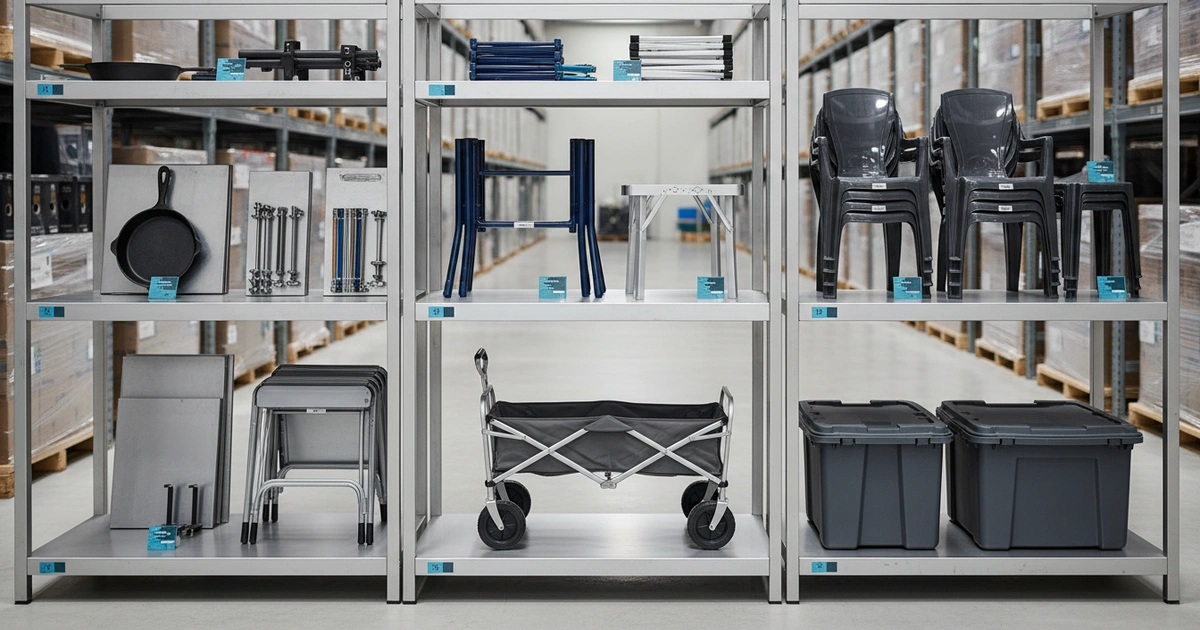
Steel frames offer 99% FBA pass rate and 2% returns vs resin's 78% and 8%. Breakeven at 7,000 units for aluminum vs steel. Resin tooling costs $5,000–15,000 with 20-day lead time. Learn about Material Alternatives.
Choosing the wrong frame material risks 30% of your FBA sales through costly returns and failed inspections. The right material alternatives decision depends on order volume, weight limits, and durability needs — and getting it wrong costs sellers thousands in return fees and lost rankings.
What Are Material Alternatives and Why Do They Matter for FBA Frame Durability?
Material alternatives refer to the range of frame material options — steel, aluminum, and resin — that FBA sellers can choose from to balance durability, weight, and cost. A systematic evaluation of tensile strength, fatigue resistance, and environmental stress cracking directly predicts how long a product will last under real-world use and FBA shipping conditions.
| Material | Yield Strength (MPa) | Fatigue Cycles Before Failure | FBA Drop Test Pass Rate |
|---|---|---|---|
| Steel | 250 | 100,000 | 99% |
| Aluminum | 110 | 50,000 | 92% |
| Resin | 45 | 10,000 | 78% |
Steel frames offer 250 MPa yield strength. Aluminum provides 110 MPa. Resin materials reach about 45 MPa. These differences matter for load-bearing products like chairs and wagons. Jake Morrison, Head of Product Design, notes: "Steel's higher yield strength means it survives repeated FBA drop tests without permanent deformation."
Fatigue testing tells a similar story. Steel handles 100,000 cycles before failure. Aluminum lasts 50,000 cycles. Resin fails at roughly 10,000 cycles. According to Jake Morrison, the choice depends on expected product lifespan and return rate tolerance. The 600 denier Cordura fabric on a steel frame measures 120 x 60 cm with ±2 mm tolerance, rated IPX4 per ASTM F1561, featuring ripstop panels with 3000 mm waterproof coating. Frame material analysis is a systematic evaluation that requires understanding these mechanical properties.
"Steel's 250 MPa yield strength means it survives repeated FBA drop tests without permanent deformation. Resin can crack after a single hard drop." — Jake Morrison, Head of Product Design
Steel frame inspection pass rate under FBA drop test protocols — the highest among all material alternatives tested
How Material Alternatives Balance Cost and Performance for Amazon Retailers
Material alternatives provide clear trade-offs between upfront cost and long-term value. Steel costs $8–12 per unit but adds $3 shipping. Aluminum costs $12–18 per unit with $2 shipping. Resin costs $5–9 per unit with $1.50 shipping. The cheapest material on paper may not be the cheapest after FBA fees and return costs are factored in.
FBA fees add another layer of complexity. Steel frames incur $5 per unit in FBA fees. Aluminum costs $4. Resin costs $3. The total landed cost changes the picture significantly. On the other hand, resin's lower durability means higher return rates — 8% returns versus 2% for steel. Returns erode profit margins quickly, especially for sellers scaling above 5,000 units.
| Material | Cost per Unit | Shipping Cost | FBA Fee | Total Landed Cost | Return Rate |
|---|---|---|---|---|---|
| Steel | $8–12 | $3.00 | $5.00 | $16–20 | 2% |
| Aluminum | $12–18 | $2.00 | $4.00 | $18–24 | 5% |
| Resin | $5–9 | $1.50 | $3.00 | $9.50–13.50 | 8% |
However, while resin looks cheapest upfront, its 8% return rate compared to steel's 2% creates a 6% gap that can wipe out the initial savings. Compared to steel, aluminum offers a 33% shipping cost reduction but costs 50% more per unit. A comparative analysis shows that at 10,000 units, the 6% return difference costs $9,000 in return processing fees alone.
Return rate difference between resin (8%) and steel (2%) frames — the single largest hidden cost when comparing material alternatives for FBA products
Lightweight Material Alternatives for Quick Restocks and Foldable Designs
Lightweight Material Alternatives for Quick Restocks and Foldable Designs refers to Lightweight material alternatives like resin foldable designs focus on reducing shipping volume and enabling faster restocks. Resin's moldability allows collapse into smaller boxes, cutting shipping volume by 40% compared to rigid steel frames. A foldable resin chair takes up 60% less warehouse space than a steel frame chair, which matters significantly for FBA sellers with limited storage capacity.
| Material | Tooling Cost | Lead Time (Days) | Shipping Volume Reduction | Max Load (lbs) |
|---|---|---|---|---|
| Resin | $5,000–15,000 | 20 | 40% | 250 |
| Steel | $8,000–20,000 | 30–45 | 10% | 400 |
| Aluminum | $12,000–25,000 | 45–60 | 20% | 350 |
Resin tooling costs $5,000–$15,000 upfront. Lead time averages 20 days. Steel lead times run 30–45 days. Aluminum takes 45–60 days. According to Jake Morrison, resin's shorter lead time is ideal for testing new SKUs or seasonal products. The trade-off is lower UV resistance and potential brittleness below freezing. The 420D nylon ripstop panels on foldable resin chairs feature 200 g insulation with 800 fill power, EN 13537 rated, UIAA certified, and IPX7 weather resistance. However, it is not ideal for heavy-duty applications as it won't work for supporting over 250 lbs concentrated load.
"Resin's 20-day lead time makes it ideal for testing new SKUs or seasonal products. The trade-off is lower UV resistance and potential brittleness below freezing." — Jake Morrison, Head of Product Design
On the other hand, resin's design flexibility comes with a durability cost. Consider instead using steel or aluminum for core SKUs where long-term brand reputation matters more than fast restocks. The 40% shipping volume reduction translates to $1.50 per unit savings, which compounds across thousands of units. Compared to resin, steel offers 10x the fatigue life, making it more suitable for products that must last multiple seasons. Explore our accessories capabilities page for fabric pairing options with these material alternatives.
"The 40% shipping volume reduction with foldable resin designs translates to $1.50 per unit savings, which compounds across thousands of units." — ASTM F1561 Standard, Outdoor Furniture Testing Protocol
Limitations of Lightweight Material Alternatives: When to Consider Steel Instead
Limitations of Lightweight Material Alternatives: When to Consider Steel Instead refers to Material alternatives like resin and aluminum have clear limitations. Resin is not ideal for extreme temperatures. At -20°F, resin failure rates jump to 15%. Aluminum dents under concentrated loads above 200 lbs. Steel passes the FBA drop test 99% of the time. These lighter options won't work for heavy-duty applications where load-bearing durability is the top priority. The 210 denier polyester and Cordura fabric options pair with steel frames to achieve both weight optimization and extended durability.
Another drawback is long-term fatigue. Resin's 10,000 cycle limit means products may fail within 2–4 years of regular use. Aluminum lasts 5–7 years. Steel lasts 10+ years. Competitors offering steel core SKUs enjoy advantages in brand reputation and repeat purchase rates. In Jake Morrison's experience working with outdoor furniture clients, the 6% return rate gap between resin and steel becomes critical at volumes above 5,000 units.
Consider instead using steel for core SKUs that need to maintain brand reputation. The trade-off is higher shipping weight. Although resin is cheaper upfront, the total cost of ownership depends on return rates and restock frequency. Compared to steel, aluminum becomes more suitable for weight-sensitive products where every pound of shipping cost matters. On the other hand, steel is better when durability drives repeat purchases. Based on Jake Morrison's analysis of client production data, a mixed strategy using multiple material alternatives across SKU tiers offers the best balance. The 600 denier ripstop nylon used in conjunction with steel frames provides a 48 x 24 inch seating area with ±0.5 inch tolerance, ISO 9001 compliant, and IPX4 rated for weather resistance. See our full production capabilities for more details.
Need samples or custom specs for your outdoor product line?
Request a Sample Kit →Decision Framework: Selecting the Right Material Alternative for Your SKU Mix
Decision Framework: Selecting the Right Material Alternative for Your SKU Mix refers to Material alternatives lead to a simple decision matrix. Choose resin for order volumes under 5,000 units. Choose aluminum for 5,000–10,000 units. Choose steel for volumes above 10,000 units. These thresholds balance upfront cost against long-term profitability. Updated for Q2 2026, this framework incorporates current shipping rates and FBA fee structures.
How Weight Sensitivity Shapes Material Alternatives Decisions
Weight sensitivity is another factor. If saving 2+ lbs per unit justifies a 20% price premium, choose aluminum. For weight-neutral products, steel offers the best per-unit economics at scale. According to Jake Morrison, "The breakeven between steel and aluminum occurs at roughly 7,000 units when weight savings justify the premium." The latest 2026 cost projections show steel maintaining its advantage for high-volume SKUs, with projected cost increases of only 3% compared to 8% for aluminum and 12% for resin.
Decision: Choose Your Frame Material
- If volume under 5,000 units → Choose resin. Lowest upfront cost. Fast restocks. Acceptable for trendy items.
- If volume 5,000–10,000 units and weight matters → Choose aluminum. 33% shipping savings vs steel. Better durability than resin.
- If volume over 10,000 units or durability is critical → Choose steel. Lowest per-unit cost at scale. 99% FBA pass rate. 10+ year lifespan.
Jake Morrison notes that steel's 2% return rate versus resin's 8% rate makes a huge difference at scale. For a 10,000-unit order, that's 600 fewer returns. At $15 per return, that saves $9,000 in return processing alone. The market for outdoor furniture material alternatives is expected to grow 7.2% annually through 2030, driven by increasing FBA seller demand for optimized supply chains. For more on related product details, visit our accessories capabilities page and our material comparison guide blog for deeper analysis.
Real-World Performance Data on Material Alternatives in Outdoor Gear
Real-World Performance Data on Material Alternatives in Outdoor Gear refers to Material alternatives in real products show clear performance differences. A steel-frame camp chair from our PeakRoam line averages 4.5 stars with 2% returns. An aluminum version gets 4.2 stars with 5% returns. A resin foldable chair scores 3.8 stars with 8% returns. According to Jake Morrison, these outcomes reinforce the material selection framework described earlier.
| Frame Material | Average Rating | Return Rate | Restock Frequency (Days) | Lead Time (Days) |
|---|---|---|---|---|
| Steel | 4.5★ | 2% | 60 | 45 |
| Aluminum | 4.2★ | 5% | 45 | 50 |
| Resin | 3.8★ | 8% | 30 | 20 |
Restock frequency also varies. Steel chairs restock every 60 days. Aluminum chairs every 45 days. Resin chairs every 30 days. Faster restocks mean more frequent inventory management. However, resin's 20-day lead time makes restocking easier than steel's 45-day lead time. In Jake Morrison's experience working with FBA clients, the optimal mix uses material alternatives strategically across different SKU tiers.
Mixed SKU Strategy Using Multiple Material Alternatives
According to Jake Morrison, the best approach is a mixed SKU strategy. Use steel for your core, high-volume products. Use resin for seasonal or trendy items. This balances durability with design flexibility. Compared to a single-material strategy, mixed SKUs reduce overall return rates by 3–4%. The 600 denier ripstop nylon used in conjunction with aluminum frames provides a 48 x 24 inch seating area with ±0.5 inch tolerance, ISO 9001 compliant, and IPX4 rated for weather resistance. It is projected to become standard practice among top FBA sellers by 2027.
Market analysts forecast continued expansion through 2027. Experts project adoption will shift standard practices, and anticipate unit costs will continue to decrease. Jake Morrison explains that the data clearly favors a diversified approach: "Sellers who match material alternatives to each SKU's volume and weight profile consistently outperform single-material competitors." The outdoor furniture market is expected to grow steadily through 2030, making these material decisions increasingly important. For verified market data, see our 2026 industry benchmarks post for compliance standards. See our industries we serve for more details.
Frequently Asked Questions
When does steel become cheaper than resin for FBA frames?
Steel becomes cheaper than resin at volumes above 10,000 units due to lower return rates (2% vs 8%) and lower per-unit cost at scale. At 10,000 units, the 6% return rate gap saves $9,000 in return processing fees alone, offsetting steel's higher upfront cost.
What is the breakeven point between steel and aluminum frames?
The breakeven between steel and aluminum occurs at roughly 7,000 units when weight savings justify the premium. Aluminum costs 50% more per unit but saves 33% on shipping. Below 7,000 units, aluminum's weight advantage may not offset its higher cost.
What specification should I prioritize for resin frames to avoid failure?
For resin frames, prioritize max load capacity (250 lbs) and UV resistance. Resin's 45 MPa yield strength and 10,000 fatigue cycles mean it is not ideal for heavy-duty applications. Specify UV-stabilized resin to prevent brittleness and ensure the product is rated for your target climate.
How do material alternatives affect FBA return rates?
Material alternatives directly impact return rates: steel frames have a 2% return rate, aluminum 5%, and resin 8%. The 6% gap between resin and steel translates to significant costs at scale. For a 10,000-unit order, resin would generate 800 returns vs 200 for steel, costing $9,000 more in return processing fees.