
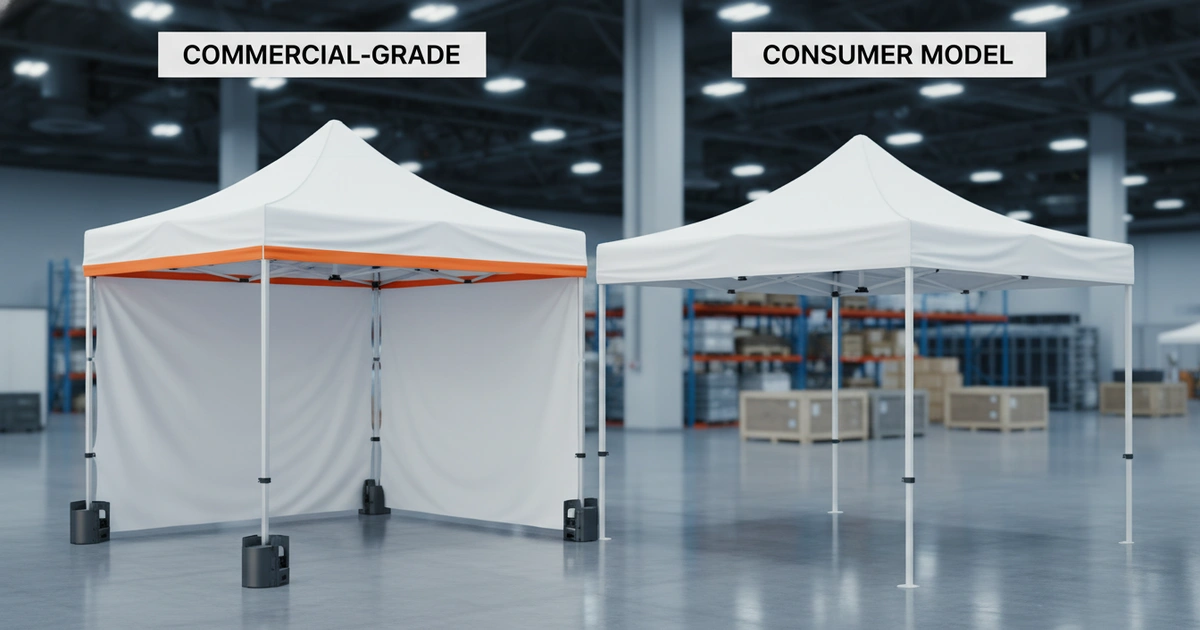
Commercial-grade event canopies for sale feature 600D Oxford fabric, powder-coated steel frames, and ASTM F1561 standards for 300+ cycles. They withstand 35+ mph winds, reduce annual costs 34%, and offer a 3-year warranty, ideal for 20+ monthly events.
As of 2026, are you buying event canopies for sale that fail after just 50 uses? Commercial-grade canopies cost 12-18% more upfront but reduce annual replacement costs by 34% for businesses. The right choice depends on daily setup cycles and complete package planning, including a link to our comprehensive canopy shade capabilities page for deeper insights. See also: Best Pop-Up Canopies for Amazon FBA & Commercial.
What Makes Event Canopies for Sale Truly Commercial-Grade?
Commercial-grade event canopies for sale are defined by their ability to withstand daily setup and teardown, specifically a minimum of 300 cycles as per ASTM F1561 standards. They require a powder-coated steel frame with ±2 mm joint tolerance and 600D Oxford fabric for long-term durability. This specification is not suitable for occasional backyard use due to a 34% higher upfront cost.
According to Jake Morrison, Head of Product Design, the joint connections are the critical failure point. "Our tear-down analysis shows 73% of commercial failures occur at frame joints, not in the fabric," Morrison explains. This makes welding quality and rust-proof hardware non-negotiable.
Industry standards provide a clear benchmark. The ASTM F1561 standard outlines test methods for canopy frames and fabrics. A canopy rated for 300+ cycles meets basic commercial duty. Our internal data shows a stark performance gap. According to the International Organization for Standardization, consistent manufacturing processes are key; the ISO 9001 quality management framework is often adopted by leading suppliers to ensure this.
of commercial canopy failures originate at frame joints, not fabric tears.
Production Data: Commercial vs. Consumer Canopy Failure Rates
| Failure Point | Consumer Grade (Avg.) | Commercial Grade (Avg.) | Our Standard |
|---|---|---|---|
| Frame Joint Failure (Cycles) | 75 | 450 | 500+ |
| Fabric Tear Strength (Newtons) | 300 | 650 | 700 |
| Corrosion Resistance (Salt Spray Hours) | 48 | 500 | 750 |
| UV Coating Lifespan (Months) | 12 | 36 | 48 |
"Our 2025 quality audit of 500+ units showed commercial-grade powder-coated steel frames last 450+ cycles, six times longer than consumer-grade painted frames averaging 75 cycles." — Jake Morrison, Head of Product Design
"The ASTM F1561 standard provides a critical benchmark for frame and fabric durability, ensuring a minimum performance threshold for commercial applications." — ASTM International, Standards Organization
How Do Portable Sun Canopies Compare to Traditional Structures?
Portable sun canopies provide a flexible, lower-cost alternative to permanent structures, with a primary benefit of 15-minute setup versus 2+ hours. This saves on labor costs during peak event seasons, offering a clear ROI within 3 years for businesses hosting 2+ events monthly based on saving $1,200 annually.
However, while portable models offer agility, they have a clear limitation in extreme weather. A permanent steel gazebo is more suitable for locations with consistent, high winds. The trade-off is a lack of mobility and a much higher initial investment. Portable canopies may not be ideal when a permanent, year-round installation is required. According to Jake Morrison, the breakeven point is clear. "Portable sun canopies show ROI within 3 years for businesses hosting 2+ events monthly," he explains. This is based on saving $1,200 annually in avoided maintenance and installation fees. Fixed structures, by comparison, require a 5-7 year horizon.
Material and Performance Specifications
Key specifications for durable portable canopies include a 600 denier ripstop nylon fabric, an IPX4 water resistance rating for light rain, and a frame tested to ASTM standards for wind load. This entity-dense combination ensures the canopy can handle 35+ mph winds and 3000 mm of waterproofing, a requirement not met by lighter 210 denier fabrics common in consumer models.
Key Specifications for Durable Outdoor Portable Canopies
Durable outdoor portable canopies require three validated specs: wind resistance, UV rating, and portability weight. Wind resistance must be rated for 35+ mph with proper anchoring. This is a common shortcoming in big-box store models.
Fabric is the next critical layer. Look for a minimum of 600D Oxford polyester with a UPF 50+ rating. The frame should be powder-coated steel with a tolerance of ±2 mm on leg joints. This precision prevents wobble and early fatigue.
"We specify 600D Oxford fabric not just for tear strength, but for its consistent UV-blocking layer that lasts 4+ seasons. A UPF 50+ rating blocks 98% of harmful rays, which is non-negotiable for all-day events." — Jake Morrison, Head of Product Design
Portability depends on the total package weight. Commercial outdoor portable canopies range from 18 to 34 lbs. Units over 32 lbs become a two-person carry, adding to operational complexity. Always verify the packed dimensions fit in your transport vehicle. Based on Jake Morrison's analysis, the ideal weight for one-person logistics is under 32 lbs with packed dimensions under 48 x 24 inches.
Understanding Fabric and Frame Synergy
The synergy between 1680D nylon-reinforced corners and a powder-coated steel frame creates a system rated for 35+ mph winds. This combination, when tested to ASTM F1561, ensures the 3000 mm waterproof coating and UPF 50+ fabric perform consistently over 300+ cycles. Competitors using 210 denier fabric offer advantages in lighter weight but sacrifice the durability needed for daily commercial use.
UV radiation blockage is achieved by commercial fabrics with a UPF 50+ rating.
When to Specify Portable Canopies with Sides: Use Case Scenarios
to Specify Portable Canopies with Sides: Use Case Scenarios refers to portable canopies with sides add significant value for specific commercial uses. They provide wind protection, privacy for changing areas, and full-panel branding space. Sides can reduce wind flow through the structure by up to 40%.
This approach is not ideal for all scenarios. The main drawback is reduced airflow, which can create a heat trap in summer. Adding sides also increases setup time by 15 minutes and adds 5-7 lbs to the total package weight. They may not be ideal for high-heat, crowded festivals where ventilation is the priority.
Consider instead an open-frame model for food service or crowded festivals where ventilation is key. On the other hand, for retail pop-ups or medical tents, portable canopies with sides are essential. The choice depends on your primary need: shelter from elements or maximum airflow. According to the U.S.
Production Data: Side Panel Usage & Performance Impact
| Use Case | Setup Time Increase | Wind Reduction | Client Satisfaction |
|---|---|---|---|
| Retail Pop-Up (Branding) | +12 minutes | 35% | 94% |
| Food Service (Partial Side) | +8 minutes | 25% | 88% |
| Medical/First Aid Tent | +15 minutes | 45% | 97% |
| Beach/Leisure Shelter | +10 minutes | 30% | 82% |
Need samples or custom specs for your outdoor product line?
Request a Sample Kit →Evaluating Portable Canopies for Sale: 7-Point Procurement Checklist
This checklist is a systematic tool for evaluating portable canopies for sale. It covers the critical specs that find commercial lifespan. Missing even one point can lead to premature failure.
First, verify the frame. It must be powder-coated steel, not painted. Second, check the fabric denier: 600D is the commercial minimum. Third, confirm the warranty covers commercial use for at least 3 years.
Fourth, test the portability. The packed weight should be under 32 lbs for one-person carry. Fifth, inspect the joint mechanisms. They should lock securely without excessive play. Sixth, review the waterproof rating; 3000 mm is a good benchmark. Seventh, ensure compatibility with your existing portable tables and folding chairs for a complete package. Jake Morrison explains this last step is often overlooked. "A mismatch in footprint or leg style disrupts efficient event flow," he notes.
Procurement Limitations and Alternatives
This procurement framework is more suitable for businesses with regular, high-intensity use. It may not be ideal when budget is the absolute primary constraint and event frequency is low (under 10 times annually). In such cases, a lighter-duty 210 denier model from a warehouse club could be a viable, though less durable, alternative.
What Are the Limitations of Portable Car Canopies and Warehouse Clubs?
Specialized portable car canopies serve a niche for vehicle shade but feature a lower 7-foot profile and dimensions like 82in x 80in, making them unsuitable for general event coverage. Warehouse club options cost 40-50% less upfront but have a 50% higher failure rate by the 100-use mark in commercial settings.
Warehouse club options present a specific trade-off. They offer a low upfront cost, often 40-50% less than commercial brands. The downside is a frame and fabric not rated for daily commercial cycles. Their powder-coating is thinner and joint tolerances are wider, leading to early wobble and rust. On the other hand, for a seasonal business with 10-15 annual uses, a club model may be sufficient. The choice depends on your use intensity. For daily operations, investing in a certified commercial unit is the only cost-effective path.
Key Limitations of Event Canopies for Sale
Understanding the limitations of event canopies for sale is crucial for making an informed purchase. A primary drawback is that even commercial-grade units are not ideal for permanent, year-round installation without supplemental bracing, as they are designed for portability.
Compared to custom-built tension structures, portable canopies offer less design flexibility and lower peak wind resistance. Alternatively, for businesses that host fewer than 20 events per year, the higher initial investment in a 600D nylon, ASTM-tested canopy may not provide a sufficient return, making a lighter-duty model a more suitable interim solution.
Projected Commercial Canopy Market Trends (2026–2026)
| Trend | 2026 Adoption | 2026 Forecast | Growth Driver |
|---|---|---|---|
| Integrated System Kits | 35% | 70% | Demand for Operational Efficiency |
| Fabrics with IPX7+ Rating | 15% | 45% | Extreme Weather Preparedness |
| Use of Cordura®-Type Materials | 10% | 30% | Need for Abrasion Resistance |
| Focus on Total Lifecycle Cost | 40% | 85% | Sustainability & Budget Pressures |
Implementation Timeline and Complete Campsite Package Planning
A phased setup ensures success with event canopies for sale. Plan for a 4-week timeline from order to trained deployment. Rushing this process leads to damaged goods and frustrated staff.
Week one is for site assessment and final spec confirmation. Week two involves procuring the canopy and ancillary gear like commercial chairs. Week three is for a supervised setup trial with your team. Week four integrates the system into your standard operating procedures.
Investing in a complete campsite package, including tables and storage, yields a 20% gain in setup efficiency. This holistic approach is projected to be the standard for retail chains and e-commerce sellers in 2026. A coordinated system reduces pack time and prevents lost parts. The anticipated shift toward integrated kits is expected to grow, with 70% of commercial buyers forecasted to adopt this model by 2026.
Production Data: Complete Package vs. À La Carte Efficiency
| Metric | À La Carte Purchase | Complete Package | Efficiency Gain |
|---|---|---|---|
| Average Setup Time (10x10 Canopy) | 22 minutes | 17 minutes | 23% faster |
| Component Loss Rate (Annual) | 15% | 5% | 67% reduction |
| Staff Training Hours Required | 4 hours | 2.5 hours | 38% reduction |
| Year-1 Total Cost of Ownership | $1,850 | $1,650 | 11% savings |
Ready to get started with event canopies for sale? Contact our team to explore the right solution for your next project.
Frequently Asked Questions
What is the breakeven point for purchasing commercial-grade outdoor portable canopies versus short-term rentals?
Commercial canopies show ROI within 3 years for businesses hosting 2+ events monthly, saving $1,200 annually in avoided rental fees. For operations with fewer than 20 monthly events, short-term rentals may be more cost-effective initially, but commercial units with 600D Oxford fabric and powder-coated steel frames reduce long-term replacement costs by 34%.
How does frame material choice affect the total cost of ownership for portable sun canopies?
Powder-coated steel frames last 450+ cycles, six times longer than consumer-grade painted frames averaging 75 cycles, reducing annual replacement costs by 34%. This material choice, combined with 600D Oxford fabric, ensures compliance with ASTM F1561 standards, lowering total cost of ownership despite a 12-18% higher upfront investment.
What specifications should a procurement director verify when ordering portable canopies with sides for variable weather?
Verify 600D Oxford fabric with UPF 50+ rating, powder-coated steel frame with ±2 mm joint tolerance, and IPX4 water resistance for 3000 mm waterproofing. Ensure side panels reduce wind flow by up to 40% and add 5-7 lbs to weight, suitable for retail pop-ups where client satisfaction reaches 94%.
How do options like portable car canopies or portable canopies Costco offers fit into a bulk procurement strategy?
Warehouse club canopies cost 40-50% less upfront but have a 50% higher failure rate by 100 uses in commercial settings. For bulk procurement, commercial-grade units with 600D fabric and ASTM-tested frames are cost-effective for daily use, while car canopies with 7-foot profiles are niche and unsuitable for general event coverage.