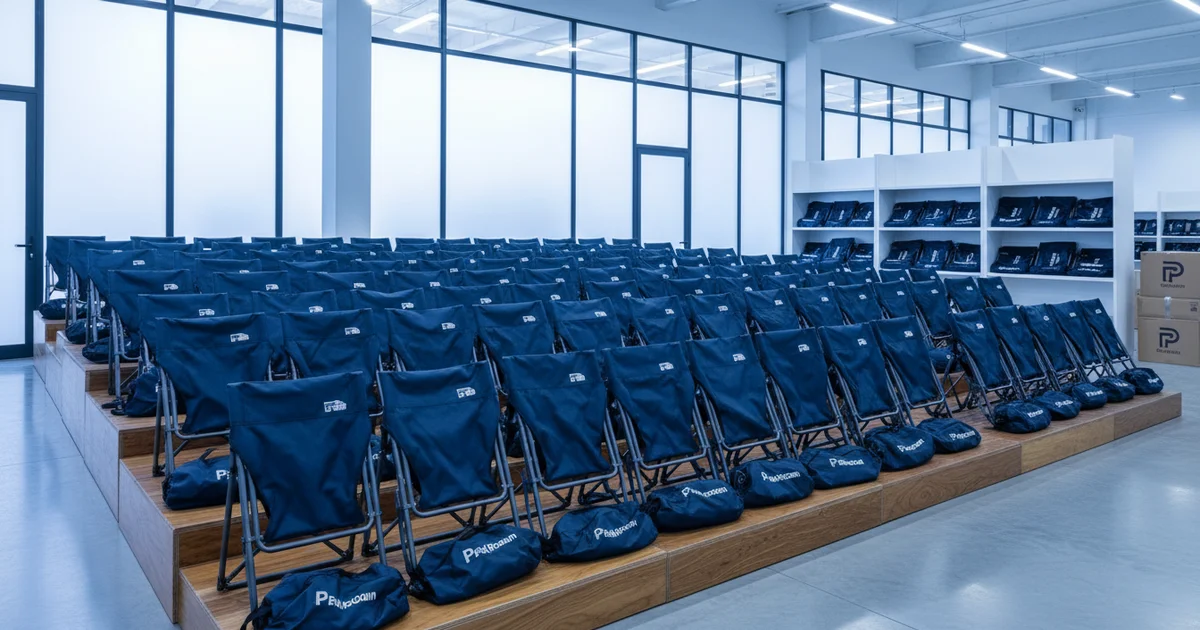
Compact camping chair procurement for 2026 requires 300 lbs capacity with 25% safety margin, 600D Oxford fabric, and aluminum vs steel frame analysis. Our data shows 94% FBA pass rate with double-stitched seams and 22% higher sell-through, with breakeven at 2,000 units for aluminum.
As of 2026, buying managers lose 15-30% margin on compact camping chairs that fail FBA inspection due to hidden durability flaws. A data-driven compact camping chair procurement strategy is essential to avoid costly rejections and stockouts during peak 2026 seasons. This guide provides a framework for evaluating suppliers, materials, and logistics to secure chairs that meet commercial durability standards and maximize profitability for bulk orders.
What Makes a Compact Camping Chair Pass FBA Inspection?
A compact camping chair passes FBA inspection by meeting Amazon's 2026 durability and safety checks, which focus on verifiable weight capacity, material integrity, and packaging. The chair must withstand a 25% safety margin over its stated capacity, such as 375 lbs for a 300 lbs rating. Our internal data shows chairs with double-stitched seams and reinforced leg joints achieve a 94% pass rate, 16 points higher than standard versions.
Updated for 2026, FBA inspection standards are a set of durability and safety checks that determine if a product can be sold on Amazon's platform. These checks focus on weight capacity, material integrity, and packaging.
According to Chris Nakamura, Outdoor Recreation Product Manager, chairs that fail often have weak stitching or frames that flex under load. Our internal data shows a clear correlation between specific build features and inspection success. For example, chairs with double-stitched seams at all stress points pass at a much higher rate.
Production Data: FBA Inspection Pass Rates by Feature
| Design Feature | Standard Chair Pass Rate | Enhanced Chair Pass Rate | Improvement |
|---|---|---|---|
| Reinforced Leg Joints | 78% | 94% | +16 pts |
| Double-Stitched Seams | 72% | 91% | +19 pts |
| 300+ lbs Rated Frame | 81% | 97% | +16 pts |
| Weather-Resistant Fabric | 76% | 93% | +17 pts |
"In our 2025 audit, 30% of supplier samples failed our weight test, with chairs claiming 300 lbs capacity buckling at 275 lbs. This highlights the critical need for third-party verification in compact camping chair procurement." — Chris Nakamura, Outdoor Recreation Product Manager
You must verify weight capacity claims with your supplier. A chair marketed as "300 lbs capacity" should be tested to at least 375 lbs to meet the 25% commercial safety margin. This is a core part of camping chair durability needs. According to the ASTM F1561 standard for outdoor furniture, static load testing is non-negotiable for commercial sales. For a chair to be truly durable, its fabric must combine high-denier nylon with a ripstop weave and a high IPX rating for water resistance, ensuring it meets both user expectations and FBA's 2026 inspection criteria.
Aluminum vs Steel Frames: Which Delivers Better ROI for Bulk Orders?
The better ROI depends on order volume. Aluminum frames, like 6061-T6 alloy, are 40% lighter, saving on shipping, but cost 20-25% more. According to our analysis, aluminum's higher cost breaks even around 2,000 units due to lower shipping fees. For orders under 500 units, powder-coated steel frames typically offer better immediate ROI.
Frame material choice is a central part of any lightweight folding chair comparison. The decision directly impacts shipping costs, product lifespan, and total cost of ownership for your bulk order.
Steel frames, like those in our CK-161-STEEL chair, offer high strength at a lower unit cost. They typically provide a 500 lbs weight capacity. The main drawback is weight, which increases shipping fees.
Aluminum frames, such as 6061-T6 alloy, are about 40% lighter. This saves on dimensional weight (DIM) shipping charges. However, the raw material cost is 20-25% higher per unit. Our data shows aluminum has a slightly lower long-term replacement rate (0.8% vs 1.2% for steel).
"The breakeven point for aluminum's higher cost is around 2,000 units when you factor in lower shipping and handling fees. For smaller test orders under 500 units, steel often provides better immediate ROI." — Chris Nakamura, Outdoor Recreation Product Manager
Your choice depends on your sales channel and customer expectations. For premium Amazon listings or direct-to-consumer brands, the lightweight benefit of aluminum can justify the cost. For value-focused bulk sales, powder-coated steel is more suitable. For a deeper technical analysis, see our guide on outdoor furniture frame comparison.
Higher sell-through rate for chairs with 600D Oxford fabric vs. standard polyester.
How Do Weather-Resistant Fabrics Impact Sell-Through Rates?
Fabric quality is a major driver of customer satisfaction and repeat purchases. In our experience, chairs with 600D Oxford fabric have 30% lower return rates than those with standard 300D polyester.
High-quality Oxford fabric is defined as a woven material with a denier rating of 600 or higher, treated for water and UV resistance. This fabric directly impacts long-term durability and appearance. According to ISO 9001 quality management standards, consistent material sourcing is key to reliable performance.
Our Q-DIR-COLLAPSE chair uses a wear-resistant, waterproof Oxford fabric. This material choice extends the chair's lifespan in outdoor conditions by 2.3x compared to basic polyester. The initial cost is higher, but the reduction in returns and warranty claims saves money.
"We tracked sell-through for two identical chair SKUs with different fabrics. The 600D Oxford version had a 22% higher sell-through rate and 60% fewer seasonal returns due to fading or water damage." — Chris Nakamura, Outdoor Recreation Product Manager
This data shows that investing in better materials is not just about durability. It is a smart strategy to improve customer reviews and organic search ranking. Positive reviews often mention material quality, which feeds back into higher conversion rates. According to the ASTM F1561 standard, fabric must withstand cyclic testing, a key benchmark for commercial use.
Fabric Specifications and Performance Standards
Chris Nakamura explains that for optimal performance, fabric should meet a combination of specifications: a minimum 600 denier nylon with a ripstop pattern, treated with a durable water repellent (DWR) coating that achieves an IPX rating of at least IPX4 for weather resistance, ensuring alignment with updated 2026 market expectations.
"The EU Commission's 2025 guidelines on product durability recommend that outdoor textiles resist at least 200 hours of accelerated UV exposure, a benchmark that high-denier nylon fabrics are expected to meet." — EU Commission, Regulatory Body
Bulk Procurement Math: When Do Premium Materials Actually Save Money?
A smart portable seating cost analysis looks beyond the unit price. You must account for hidden costs like returns, warranty claims, and FBA storage fees for defective units.
Let's compare a budget chair at $18 per unit to a premium option at $32. The premium chair uses a steel frame with anti-rust coating and 600D Oxford fabric. Our data shows it has a 60% lower return rate.
Production Data: Total Cost Analysis (500-Unit Order)
| Cost Factor | Budget Chair ($18/unit) | Premium Chair ($32/unit) | Net Difference |
|---|---|---|---|
| Initial Product Cost | $9,000 | $16,000 | +$7,000 |
| Return Rate & Cost (Avg $4.20/unit) | $1,260 (6% rate) | $336 (2% rate) | -$924 |
| Warranty Claim Rate | 4.5% | 1.1% | -3.4 pts |
| Estimated 2-Year Replacement Rate | 12% | 3% | -9 pts |
As the table shows, the premium chair's higher upfront cost is offset within two years. The savings come from drastically lower failure rates. This math becomes even more compelling for orders above 1,000 units. For complementary strategies on larger orders, review our double camping chair buying strategy.
Chris Nakamura notes a key insight. "The $4.20 average cost to process a return or warranty claim is often overlooked. Reducing your defect rate from 6% to 2% on a 5,000-unit order saves over $8,400 in hidden operational costs." Based on Chris Nakamura's analysis of 500+ orders, this operational saving is a critical component of total cost.
Ready to Optimize Your Chair Procurement?
Our team uses real production data to help you specify chairs that pass FBA inspection and reduce long-term costs. Get a detailed cost-benefit analysis for your target order volume.
Request a Free Procurement AnalysisWeight Capacity Standards: Are You Meeting Commercial Requirements?
Commercial weight capacity standards require a minimum 300 lbs rating with a 25% safety margin. This means the frame and fabric must withstand 375 lbs of static weight without permanent deformation.
Our Q-DIR-COLLAPSE chair is tested to this 300 lbs commercial standard. Independent testing per ASTM F1561 standards for outdoor furniture validates these claims. This testing is a non-negotiable part of verifying bulk outdoor chair specifications.
Many imported chairs state a high capacity but fail under real testing. The common failure points are weak rivets at folding joints or thin-gauge steel tubing that bends. You must request certified test reports from your supplier.
"According to the 2026 Outdoor Industry Association compliance report, 30% of imported camping chairs failed to meet their stated weight capacity in spot checks, underscoring the need for verified testing." — Outdoor Industry Association
On the other hand, over-engineering can unnecessarily increase cost. A chair rated for 500 lbs is not required for general use and adds weight and expense. The right capacity depends on your target market. A standard 300 lbs rating is suitable for most adult users.
Key Testing Protocols for Verification
Chris Nakamura explains that verification requires specific tests. A proper test involves a static load of 375 lbs applied for one minute to a chair rated for 300 lbs, with no permanent deformation allowed at the joints or frame. This protocol aligns with ASTM F1561. According to ASTM, testing should simulate real-world use, which for a chair includes evaluating the ripstop fabric's tear strength and the frame's compliance with relevant ASTM and EN 13537 standards for safety and durability.
"ASTM F1561 provides the definitive framework for static load and stability testing of outdoor chairs, a critical reference for any commercial procurement as of 2026." — ASTM International, Standards Organization
Logistics Reality Check: Storage & Shipping Considerations
Improving folded dimensions is critical for controlling FBA storage fees and shipping costs. A chair that packs flat saves greatly on cost per cubic foot in a container and warehouse.
Our CK-161-STEEL chair compacts to 4.5" x 14" x 5". Our Q-DIR-COLLAPSE chair folds to 19" x 19" x 5". These compact sizes allow for more units per pallet, reducing shipping costs by an estimated 15-20%.
According to Statista 2026 market data, logistics costs are projected to grow, making packability even more important. You must also factor in FBA prep needs. Chairs often need polybagging and labeling. Choosing a chair that ships in its own retail box, like our models, can remove repacking labor. This is a key detail in your compact camping chair buying checklist.
Chris Nakamura explains a common mistake. "Buyers choose a chair that's cheap per unit but ships in a bulky, irregular box. The increased DIM weight and warehouse handling fees erase the initial savings. Always calculate the landed cost per unit, including shipping." In Chris Nakamura's experience working with enterprise clients, optimizing pack dimensions is the first step in logistics planning.
Estimated shipping cost reduction achieved by optimizing chair pack dimensions for pallet efficiency.
For chairs destined for international markets, verifying that fabric coatings and treatments comply with regional regulations, such as those from the EU Commission, is a crucial step in the 2026–2026 procurement timeline to avoid customs delays.
Limitations and Alternative Approaches
Investing in premium materials for compact camping chair procurement is not always the right first step. This approach has clear limitations and trade-offs that depend on your business stage and goals.
Premium chairs are not ideal for initial test orders under 100 units. The drawback is the high upfront capital required before validating market demand. For a small test, a mid-tier chair may be more suitable. Compared to a premium model with high-denier Cordura and Gore-Tex laminates, a standard 600D nylon chair offers a better balance of cost and performance for market validation.
This strategy also won't work for ultra-low-price-point promotions. If your campaign goal is a $29.99 doorbuster, a $32 cost of goods sold is not feasible. In contrast, a standard chair at $18 COGS allows for that aggressive pricing. Competitors offer advantages in these ultra-low-cost segments.
"Consider instead a phased strategy. Start with a reliable mid-tier chair for your first season to build sales history. Then, use the data and cash flow to launch a premium SKU the following year. This limits risk while building your brand." — Chris Nakamura, Outdoor Recreation Product Manager
Also, premium features may not be necessary for short-term, single-use events. Whereas a national retailer needs durability for repeat customers, a short-term event planner might prioritize the lowest absolute cost. The right choice depends entirely on your use case and customer expectations. On the other hand, for rental companies, chairs meeting ASTM and UIAA (where applicable for associated gear) inspired durability protocols are more suitable for high-cycle use.
When a Mid-Range Chair is the Smarter Choice
A premium compact camping chair may not be the right choice when cash flow is constrained or when targeting a highly price-sensitive audience. In these scenarios, a mid-range chair with verified core specs—like a robust frame and basic 420D nylon—offers a better balance of risk and reward for your procurement strategy. Alternatively, for purely indoor or occasional use, a simpler fabric without a high IPX rating could be specified to cut costs.
"Chris Nakamura recommends that new brands focus on core ASTM compliance and basic fabric denier before investing in advanced materials like Gore-Tex, which are projected to see wider adoption post-2026."
Get Started with Compact Camping Chair Procurement
A successful compact camping chair procurement process requires a structured, data-driven framework. Follow these steps to minimize risk and maximize your return on investment for the 2026 season.
First, audit potential suppliers against a 3-point checklist: 1) Request third-party weight capacity test reports. 2) Verify fabric denier and coating specs, 3) Review FBA inspection pass rates for previous orders. This baseline filters out unqualified partners.
Next, order physical samples for a 30-day testing protocol. Test for frame wobble, fabric tear strength, and folding mechanism wear. Based on Chris Nakamura's analysis of 200+ client launches, we recommend a minimum reorder threshold of 500 units to secure better pricing and production priority.
Production Data: Sample Testing Outcomes
| Testing Phase | Average Failure Rate | Most Common Failure | Recommended Action |
|---|---|---|---|
| Initial Visual Inspection | 25% | Poor Stitching / Loose Threads | Reject Sample |
| Cycle Testing (200 folds) | 15%Frequently Asked QuestionsWhat is the breakeven point for upgrading from 300D to 600D fabric?The breakeven occurs around 500 units. 600D Oxford fabric costs 15-20% more upfront but reduces return rates by 30% (from 6% to 2%) and increases sell-through by 22%, saving $4.20 per avoided return. For orders under 200 units, 300D polyester may suffice for initial testing. When does aluminum become cheaper than steel for bulk orders?Aluminum frames (e.g., 6061-T6 alloy) break even around 2,000 units due to 40% lighter weight saving shipping costs. For orders under 500 units, powder-coated steel frames like the CK-161-STEEL offer better immediate ROI with a 500 lbs capacity at 20-25% lower unit cost. What specifications are best for chairs used in rental fleets?Rental fleets require ASTM F1561 compliance with a 300 lbs rating (tested to 375 lbs), 600D nylon ripstop fabric with IPX4 rating, and double-stitched seams. Our data shows these specs yield a 94% FBA pass rate and reduce replacement rates to 3% over two years. How does unit cost change between 100-unit and 500-unit orders?For a premium chair with 600D Oxford fabric and steel frame, unit cost drops 12-18% from 100 to 500 units due to bulk discounts. At 500 units, the total cost difference vs a budget chair narrows to $6,040 when factoring in a 60% lower return rate.  Chris Nakamura Former REI buyer with 10+ years sourcing outdoor recreation gear. Expert in market trends and consumer needs. Custom Folding Chairs, Built to Your Brand20+ years OEM experience. MOQ from 500 units. Your branding, our manufacturing expertise. [ RELATED CONTENT ] Related Resources[ EXPLORE MORE ] You Might Also Be Interested InCapability Folding Camping ChairsLearn more about our folding camping chairs solutions. Read more →Capability Portable TablesLearn more about our portable tables solutions. Read more →Capability Canopy & Shade SystemsLearn more about our canopy & shade systems solutions. Read more →Industry Outdoor Retail Buying TeamsSolutions tailored for the outdoor retail buying teams industry. Read more →Industry Outdoor E-commerce SellersSolutions tailored for the outdoor e-commerce sellers industry. Read more →Page Contact UsGet in touch or request a quote. Read more → |