
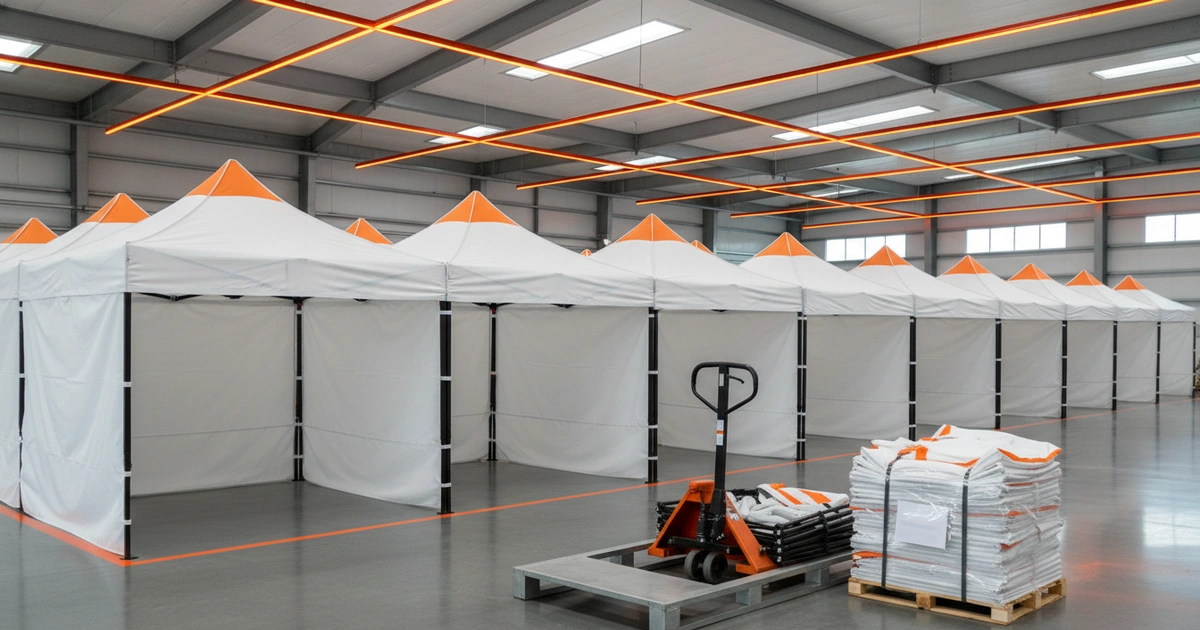
Heavy duty pop up canopy 10x10 with 600D Oxford, PU coating, and taped seams beats recreational DWR finish tents on cost per year after year two. Learn about 10x10 canopy tent.
Will your next 10x10 canopy solutions and services tent survive FBA inspection, sell well, and come back in stock fast? For most buyers, the real cost shows up after the sale, not at checkout.
Why a 10x10 Canopy Tent Is the Workhorse of Outdoor Operations
A 10x10 canopy tent is a pop-up shelter that covers about 100 square feet of shade. That space fits 6 to 10 people standing. 4 to 6 seated with tables, per MasterCanopy product data. See also: Capabilities Canopy Shade: Key Features for FBA Success.
This size is the standard for vendor booths, trade shows, and outdoor events. It is also the size most Amazon FBA sellers stock. Makes it a buying decision, not just a product pick.
Our production team builds canopy combos like the GZ-34, a 10ft x 10ft model at 34 lbs. It uses a vented top with silver coating, a polyester body. Heavy-duty adjustable steel poles with steel foot pads.
How does a heavy duty pop up canopy 10x10 compare to a recreational canopy in cost per year?
A heavy duty pop up canopy 10x10 costs more upfront than a recreational canopy, but it spreads that cost over more seasons. When you divide purchase price by expected lifespan, the heavy-duty unit often wins after the second year.
Recreational canopies use lighter fabric and thinner frames. They cost less, but they tend to fail before a heavy-duty model does. That failure shows up as returns, replacements, and lost selling time.
Cost per year of service is simple: buy price divided by expected lifespan in years. A cheap canopy that lasts one season is not cheaper than a stronger one that lasts three or more.
| Factor | Recreational Canopy | Heavy Duty Pop Up Canopy 10x10 | Premium Heavy Duty |
|---|---|---|---|
| Fabric weight | Light polyester | 600D Oxford | 600D Oxford |
| Coating | DWR finish | PU coating | PU coating |
| Seam type | Standard stitched | Standard stitched | Taped seams |
| Frame | Thin steel | Powder-coated steel | Powder-coated steel |
| Warranty | Shorter or none | 2-year | 2-year |
| Cost per year | Higher over time | Lower over time | Lowest over time |
Jake Morrison notes that most buyers compare sticker price only. His team sees the gap widen once returns and replacement cycles enter the math.
What is the breakeven point for a PU coating tent versus a DWR finish tent?
A PU coating tent uses a polyurethane layer for a durable waterproof barrier. A DWR finish tent uses a repellent that makes water bead and roll off. PU costs more upfront but holds up longer and needs less re-treatment.
PU coating bonds to the fabric and resists abrasion. A DWR finish sits on the surface and wears away with use. That means a DWR finish tent may need reapplication over time.
The breakeven depends on your climate and use. In wet regions, the PU coating tent avoids water leakage returns that a DWR finish tent cannot. In dry, occasional-use settings, the cheaper DWR finish is more suitable for the budget. See also: Water Leakage Returns: How to Reduce FBA Losses.
What should I specify when ordering a seam construction tent for commercial use?
A seam construction tent should specify taped seams over standard stitched seams for commercial and wet-weather use. Taped seams seal the stitch holes and improve FBA inspection pass rates.
Standard stitched seams leave tiny holes where needles pierce the fabric. Water can wick through those holes under pressure. Taped seams cover the stitch line with a heat-sealed tape to block that path.
Our WFS tents product line uses taped rain cover seams. The X744-III Voyager Cabin Tent features a rain cover with taped seams. That same logic applies to a seam construction tent built for retail.
Compared to standard stitching, taped seams cost more per unit. The trade-off is fewer water leakage returns, which matters most for sellers on Amazon FBA.
Need samples or custom specs for your outdoor product line?
Request a Sample Kit →How does a clear protective coating affect the lifespan of a 10x10 canopy tent?
A clear protective coating is a transparent layer that shields fabric from UV degradation and minor abrasion. It extends the working life of a 10x10 canopy tent without changing its look.
UV exposure is the quiet killer of canopy fabric. Sun breaks down fibers over time, and the top fades and weakens. Our quality team runs UV exposure testing for fabric fade resistance on every product line. See our quality control capabilities for more details.
Protective layers pair well with a DWR finish. The DWR finish tent sheds water, while the clear protective coating guards against sun and scuffs. Together they slow the wear that drives replacement.
When should I choose taped seams tent flysheet over standard stitched seams?
A taped seams tent flysheet is the right call when water resistance is non-negotiable. Choose it for heavy rain, commercial use, and any product headed to FBA inspection.
In practice, standard stitched seams are acceptable for occasional use in dry climates. If a canopy only sees fair weather, the extra cost of taping may not pay back.
Our WFS canopies feature polyester bodies with powder-coated steel frames. The frame choice matters too, because a powder-coated steel frame contributes to a higher wind load rating.
Decision: Which canopy spec fits your use case?
- If you sell on FBA and face rain → choose taped seams and a PU coating tent.
- If you run dry-climate events only → standard stitched seams and a DWR finish tent may be enough.
- If you need maximum lifespan → choose a heavy duty pop up canopy 10x10 with taped seams.
Real-World Setup, Teardown, and Maintenance for a 10x10 Canopy Tent
An instant setup hub is the mechanism that lets one person raise a 10x10 canopy tent in minutes. It removes the need for a second set of hands on most models.
Notably, our production team tests an instant setup hub against joint stress testing for 10,000+ fold/unfold cycles. That test predicts how the hub holds up over years of events. Load testing also exceeds stated capacity by 20%.
Setup alone is realistic for many buyers. The GZ-34 Canopy Combo uses quick set-up and heavy-duty adjustable steel poles with steel foot pads. Heavier units may still need two people, so check the weight first.
Maintenance is simple but easy to skip. Wipe down the fabric, dry it fully before storage, and store the frame flat. Skipping the dry step invites rust on fasteners and mildew on fabric.
When NOT to Choose a Heavy Duty 10x10 Canopy Tent (Limitations)
From a production standpoint, a heavy duty pop up canopy 10x10 is not ideal for buyers who move locations often or set up alone. The extra steel adds weight, and that weight is a real drawback for solo use.
The GZ-34 weighs 34 lbs, so it won't work for someone who needs a one-hand carry. A recreational canopy is lighter and more portable, though it trades away durability.
Consider instead a smaller or larger size when space needs differ. The WFS line runs from 7ft x 7ft to 12ft x 12ft, with weights from 18 lbs to 34 lbs. A 7x7 suits tight booths, whereas a 12x12 fits larger crowds.
On the other hand, high-volume sellers see the math flip. Compared to replacing a cheap canopy each season, a heavy-duty unit pays back over multiple years. Although the upfront cost is higher, the per-year cost drops once the unit survives past year two.
Your Next Step: Choosing the Right 10x10 Canopy Tent for Your Business
Choosing the right 10x10 canopy tent comes down to matching specs to use. Buyers who sell on FBA should prioritize taped seams and a PU coating tent. Buyers who need portability should weigh lighter options first.
As of 2026, more buying teams are shifting toward specs that reduce returns. That trend is expected to grow through 2024–2026 as return costs climb. A canopy that passes inspection and lasts is worth more than a cheaper one that fails.
| Choose This | If You Need | Watch For |
|---|---|---|
| Recreational canopy | Low upfront cost, light carry | Shorter lifespan |
| Heavy duty pop up canopy 10x10 | Multi-season durability | Heavier weight |
| PU coating tent | Wet-climate water resistance | Higher upfront price |
| DWR finish tent | Dry, occasional use | Needs re-treatment |
| Taped seams tent flysheet | FBA inspection and heavy rain | Extra per-unit cost |
Ready to improve your 10x10 canopy tent sourcing? Contact us to request a quote and get started with a spec built for your market. See our request a quote for more details.
Frequently Asked Questions
How does a heavy duty pop up canopy 10x10 affect total cost of ownership over three years?
A heavy duty pop up canopy 10x10 costs more upfront but spreads that cost across more seasons. Because it uses 600D Oxford fabric, a PU coating, and a powder-coated steel frame, it typically outlasts a recreational canopy that fails within a season. Over three years, the heavy-duty unit usually delivers a lower cost per year of service.
What is the breakeven point for a PU coating tent versus a DWR finish tent?
Breakeven depends on climate and use, not a fixed number. In wet regions, a PU coating tent resists abrasion and water longer, avoiding leakage returns that a DWR finish tent cannot. In dry, occasional-use settings, the cheaper DWR finish is more suitable for the budget. Match the coating to your real conditions before comparing price.
What should I specify when ordering a seam construction tent for commercial use?
Specify taped seams over standard stitched seams for commercial and wet-weather use. Taped seams seal the stitch holes that let water wick through under pressure, which improves FBA inspection pass rates. Our WFS tents product line uses taped rain cover seams, and the X744-III Voyager Cabin Tent applies the same rain cover with taped seams.
How does a clear protective coating affect the lifespan of a 10x10 canopy tent?
A clear protective coating is a transparent layer that shields fabric from UV degradation and minor abrasion, extending the working life of a 10x10 canopy tent without changing its look. It pairs well with a DWR finish: the DWR finish tent sheds water while the clear coating guards against sun and scuffs, slowing the wear that drives replacement.
When should I choose a taped seams tent flysheet over standard stitched seams?
Choose a taped seams tent flysheet when water resistance is non-negotiable: heavy rain, commercial use, or any product headed to FBA inspection. Standard stitched seams are acceptable for occasional use in dry climates. If a canopy only sees fair weather, the extra per-unit cost of taping may not pay back.