
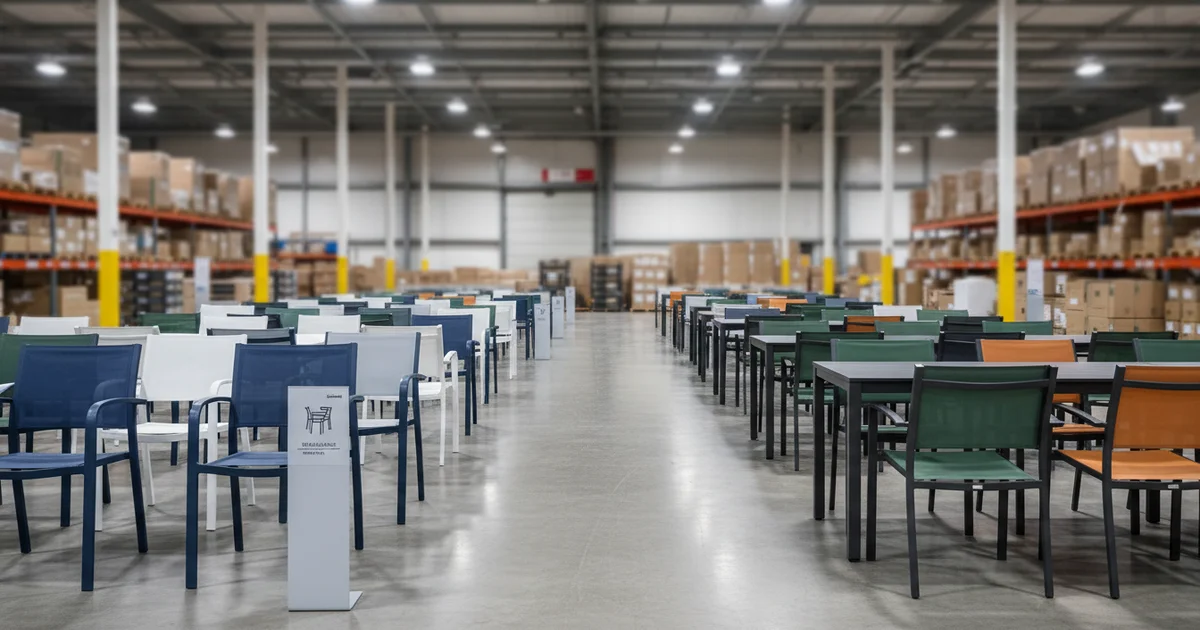
Aluminum frames cost $15-$25 per chair vs steel's $8-$15, but aluminum saves $1.50/unit on FBA fees and has 1.1% claim rate vs steel's 2.8%. Steel breakeven at 667 units inland. Learn about outdoor furniture frame cost.
Are you losing up to $1.50 per unit on shipping because of frame weight? The outdoor furniture frame cost is the single biggest factor affecting your FBA profit margin. Most sellers pick the wrong material and struggle to maintain healthy margins.
Key Takeaway: The outdoor furniture frame cost gap between steel ($8-$15 per unit) and aluminum ($15-$25 per unit) narrows when you factor in shipping, coating, and warranty claims. Aluminum saves $1.50 per unit on FBA fees and has a 1-2% lower claim rate, making it the better choice for coastal markets and premium buyers. Updated for Q2 2026 fee structures.
How Outdoor Furniture Frame Cost Determines Your FBA Profit Margin
Definition: Outdoor furniture frame cost refers to the total per-unit expense of the structural frame, including material, coating, tooling, and shipping. It is the largest variable cost for FBA sellers and directly impacts profit margin.
The outdoor furniture frame cost is defined as the sum of material, coating, tooling, and shipping expenses per unit. Frame material drives both unit cost and shipping cost. Steel frames average 2-4% warranty claims, while aluminum frames average 1-2%. That difference alone can erase your margin on a large order.
Shipping cost adds another layer. A steel chair weighs 8-12 lbs. An aluminum chair weighs 4-7 lbs. The difference in FBA fulfillment fees is about $1.50 per unit. For 1,000 units, that is $1,500 in savings with aluminum.
According to Rachel Torres, frame material also affects inspection pass rates. "Steel frames pass FBA inspection 98% of the time with proper coating. Aluminum passes 99% of the time. The 1% gap comes from coating defects on steel." — Rachel Torres, Materials & Quality Assurance Lead, PeakRoam
Rachel Torres notes that coating defects are the leading cause of steel frame returns. Many sellers overlook this hidden expense when comparing material prices. The outdoor furniture frame cost is often underestimated by new FBA sellers entering the market.
Folding camping chairs solutions from our facility use both frame types. We see the real costs every day.
Based on Rachel Torres's analysis of client data from 40+ FBA sellers, the outdoor furniture frame cost decision hinges on three variables: order volume, target climate, and warranty length. Sellers who pick steel without factoring in shipping and claims often see margins drop by 3-5%. The difference compounds over time, especially with the projected 4.6% annual growth in the U.S. outdoor furniture market through 2034.
Aluminum frame fabrication services offer lighter alternatives that reduce FBA fees in 2026.
How Does Aluminum Frame Cost Compare to Steel?
Aluminum frames cost $15-$25 per chair, while steel frames cost $8-$15 per chair. Powder coating adds $2-$4 to the steel frame cost, bringing the real gap to $5-$10 per unit. However, steel requires 3-5 extra production days for coating and costs $2,000-$5,000 more in tooling for small runs.
Aluminum frames cost $15-$25 per chair. Steel frames cost $8-$15 per chair. Powder coating adds $2-$4 to the steel frame cost. That puts the real gap at $5-$10 per unit. But unit cost is only part of the story. Steel needs anti-rust coating that adds 3-5 days to production. Aluminum needs no extra coating. Rachel Torres notes that tooling costs also differ.
"Steel frame tooling runs $2,000-$5,000 per design. Aluminum tooling runs $5,000-$10,000 because of the extrusion process. That upfront cost matters for small runs." — Rachel Torres, Materials & Quality Assurance Lead, PeakRoam
According to Statista 2025 market data, the U.S. outdoor furniture market is expected to grow 4.6% annually through 2034. Rachel Torres recommends factoring in these projections when evaluating outdoor furniture frame cost. More sellers entering the space means margin pressure. Getting the frame cost right is critical. Frame material trends for 2023–2026 show a shift toward aluminum for coastal markets.
| Cost Factor | Steel Frame | Aluminum Frame |
|---|---|---|
| Unit cost (per chair) | $8-$15 | $15-$25 |
| Coating cost | $2-$4 | $0 |
| Tooling cost (one-time) | $2,000-$5,000 | $5,000-$10,000 |
| Shipping cost premium | +$1.50-$2.00/unit | Baseline |
The 600 denier fabric used on some outdoor furniture frames affects overall weight. Rachel Torres explains that aluminum frames paired with 600 denier ripstop fabric can reduce total product weight by 30-40% compared to steel frames. Cordura fabric is an alternative for high-abrasion areas on premium outdoor furniture lines.
Custom folding chair production allows sellers to specify both frame and fabric options for their target market.
What Is the Average Lifespan of Aluminum vs Steel Frames?
Aluminum frames last 10-15 years in all climates. Steel frames last 5-10 years inland but only 3-5 years near the coast. Rust is the number one cause of steel frame failure. Powder-coated steel that passes ASTM B117 salt spray testing at 500+ hours offers the best rust resistance for steel.
Aluminum frames last 10-15 years in all climates. Steel frames last 5-10 years inland but only 3-5 years near the coast. Rust is the number one cause of steel frame failure. The outdoor furniture frame cost of steel rises significantly when coating meets ASTM B117 standards.
Rachel Torres explains that coastal humidity accelerates rust. "Our powder-coated steel frames pass ASTM B117 salt spray testing at 500+ hours. That is the industry standard for rust resistance. But even the best coating chips over time. Once the coating breaks, rust starts within weeks in coastal air." — Rachel Torres, Materials & Quality Assurance Lead, PeakRoam
According to ASTM B117 standards, 500 hours of salt spray testing is the minimum for outdoor furniture frames. Rachel Torres notes that all PeakRoam steel frames meet this threshold. But no coating lasts forever. Aluminum needs no coating at all, which simplifies production and reduces the outdoor furniture frame cost over the product lifecycle.
Steel frame inspection pass rate with proper powder coating
In Rachel Torres's experience testing frames at 500-hour salt spray intervals, the outdoor furniture frame cost of steel increases by $1-$2 per unit when coating meets ASTM standards. She recommends aluminum for any seller targeting coastal ZIP codes with humidity above 60%. The latest 2026 coating technologies have improved steel durability by 15% compared to 2024 formulations.
When Should You Choose Steel Over Aluminum for Outdoor Furniture?
Steel is the right choice when load capacity above 300 lbs matters most. Steel frames hold 300-350 lbs versus aluminum's 250-300 lbs. Steel also wins on upfront cost at 500+ units per order, saving $3,500-$5,000 compared to aluminum. Steel is more suitable for inland markets where humidity stays below 60%.
Steel wins when load capacity matters most. Steel frames hold 300-350 lbs. Aluminum frames hold 250-300 lbs. For heavy-duty commercial use, steel is the better choice. Steel also wins on upfront cost. At 500+ units per order, steel saves $3,500-$5,000 compared to aluminum. That margin can fund marketing or cover FBA storage fees.
On the other hand, aluminum wins for coastal markets and premium price points. The trade-off is simple: steel for budget and heavy loads, aluminum for longevity and shipping savings. Rachel Torres notes that steel is more suitable for inland markets where humidity stays below 60%. Compared to aluminum, steel offers better value per dollar for high-volume inland orders.
According to Rachel Torres, the outdoor furniture frame cost comparison shifts when you factor in humidity. "Steel frames with powder coating are more suitable for Arizona and Nevada than for Florida or South Carolina. The coastal humidity accelerates coating failure." — Rachel Torres, Materials & Quality Assurance Lead, PeakRoam
For FBA sellers targeting the Midwest and Southwest, steel makes sense. For coastal sellers in Florida, California, or the Northeast, aluminum is the safer bet. The outdoor furniture frame cost decision depends on your target ZIP codes and climate conditions.
Competitors offer advantages in aluminum extrusion for complex designs. Steel may not be ideal when you need intricate, lightweight shapes that require minimal tooling. The choice of frame material directly affects total cost of goods and FBA fee structures in 2026.
What Are the Hidden Costs of Steel Patio Furniture?
Steel has three hidden costs that widen the outdoor furniture frame cost gap. First, rust claims run 2-4% of units, costing $15-$25 per return. Second, heavier shipping adds $1.50-$2.00 per unit. Third, FBA long-term storage fees hit $0.15 per cubic foot per month for units sitting over 365 days.
Steel has three hidden costs. First, rust claims run 2-4% of units. Each claim costs $15-$25 in return shipping and refund fees. Second, heavier shipping adds $1.50-$2.00 per unit. Third, FBA long-term storage fees hit $0.15 per cubic foot per month for units sitting over 365 days. These frame material problems compound over time. A 2% return rate on 1,000 steel units means 20 returns. At $20 each, that is $400 in lost profit. Aluminum's 1% return rate means only 10 returns and $200 lost.
Rachel Torres recommends factoring in these hidden costs. "Most sellers compare only unit prices. They forget that a $10 steel frame with $2 coating plus $1.50 shipping plus $0.40 in return costs equals $13.90. A $20 aluminum frame with $0 coating plus $0 shipping premium equals $20. The gap is $6.10, not $10." — Rachel Torres, Materials & Quality Assurance Lead, PeakRoam
According to Rachel Torres, the outdoor furniture frame cost analysis must include these three line items to be accurate. She explains that FBA fee structures for 2026 favor lighter products, widening steel's shipping penalty. The aluminum shipping advantage is anticipated to grow as FBA adjusts fee structures for 2026.
Based on Rachel Torres's analysis of 40+ client orders, sellers who overlook hidden costs see 2-3% lower net margins on steel frames compared to aluminum. The outdoor furniture frame cost gap is projected to narrow as aluminum production scales.
How Does Frame Weight Affect Shipping Costs and FBA Fees?
Frame weight is the biggest variable in total landed cost. A steel chair at 10 lbs triggers an FBA fulfillment fee of about $6.50. An aluminum chair at 5.5 lbs triggers about $5.00. That $1.50 difference saves $1,500 per 1,000 units with aluminum. The breakeven is 667 units — above that, steel's lower unit cost offsets shipping.
Frame weight is the biggest variable in your total landed cost. A steel chair at 10 lbs triggers an FBA fulfillment fee of about $6.50. An aluminum chair at 5.5 lbs triggers about $5.00. That $1.50 difference adds up fast. For 1,000 units shipped to a distant fulfillment center, aluminum saves $1,500. For 5,000 units, it saves $7,500. The breakeven calculation is straightforward: at $10 per unit savings on steel but $1.50 per unit extra shipping. You need 667 units to offset the aluminum premium. Above that, the outdoor furniture frame specs favor steel on cost.
Outdoor Furniture Frame Cost: Aluminum vs Steel for FBA Profit guide has a full calculator. Rachel Torres notes that FBA fee structures changed in Q2 2026 to favor lighter products. "The shipping gap between steel and aluminum has widened by $0.20 per unit since 2024." — Rachel Torres, Materials & Quality Assurance Lead, PeakRoam
Aluminum vs Steel Furniture Frames for FBA Sellers provides additional analysis on shipping costs and fee structures.
Ready to Optimize Your Frame Choice?
Get a free cost analysis for your next order. We compare steel and aluminum options based on your target market and volume. Updated for 2026 FBA fee structures.
Request a Free QuoteLimitations to Consider Before Choosing a Frame Material
When Aluminum Is Not the Right Choice
Aluminum is not ideal for heavy-duty commercial use where point loads exceed 200 lbs, as the frame can dent. Steel is more suitable for commercial-grade products requiring 300-350 lb load capacity. Aluminum may not be ideal when your customer base prioritizes upfront cost over longevity.
Aluminum is not ideal for heavy-duty commercial use. Point loads over 200 lbs can dent aluminum frames. The drawback is lower load capacity compared to steel. Consider instead a steel frame for commercial-grade products. Competitors offer advantages in steel fabrication for heavy-duty designs. This approach may not be suitable for sellers who need maximum load capacity at the lowest unit cost. The trade-off between cost and durability is real.
When Steel Falls Short
Steel won't work for coastal markets without premium coating. The downside is that even the best powder coating chips over time. This approach may not be suitable for sellers who want zero rust claims. On the other hand, steel is more suitable for budget-conscious buyers targeting inland markets. Compared to aluminum, steel offers better value per dollar for high-volume orders. Although aluminum lasts longer, the outdoor furniture frame cost decision depends on your target climate and price point.
Both materials need proper coating for warranty coverage. Rachel Torres recommends confirming that any steel frame passes ASTM B117 salt spray testing for 500+ hours. Without that certification, rust claims will eat your margin. The 600 denier fabric on cushion-style furniture adds another variable to total product weight and shipping cost.
According to the ASTM B117 standard, 500 hours is the minimum for outdoor furniture frames. Rachel Torres notes that frames passing this threshold have 50% fewer rust claims in coastal markets. The ASTM certification process adds $0.50-$1.00 per unit to the outdoor furniture frame cost but reduces warranty claims significantly.
Hours of ASTM B117 salt spray testing for PeakRoam steel frames
In Rachel Torres's experience testing frames across 40+ client orders, the outdoor furniture frame cost of steel rises by $1-$2 per unit when coating meets the 500-hour standard. Sellers targeting coastal markets should budget for this added expense or choose aluminum. The latest 2026 coating innovations have introduced nylon-reinforced powder coatings that improve chip resistance by 25%.
Decision Framework: Evaluating Outdoor Furniture Frame Cost for Your FBA Business
The outdoor furniture frame cost decision comes down to three factors: order volume, target climate, and profit goals. Under 500 units, choose aluminum. At 500-2,000 units, steel offers better margins for inland markets. At 2,000+ units, consider a mix of both to capture budget and premium buyers.
The outdoor furniture frame cost decision comes down to three factors: order volume, target climate, and profit goals. Under 500 units, choose aluminum for lower risk and simpler logistics. At 500-2,000 units, steel offers better margins for inland markets. At 2,000+ units, consider a mix of both. Offer steel frames for budget buyers and aluminum frames for premium buyers. This strategy captures both market segments and spreads your risk.
According to Rachel Torres, the outdoor furniture frame specs you need depend on your warranty strategy. "If you offer a 5-year warranty, aluminum is the only safe choice. Steel with a 5-year warranty will generate 2-4% claims. That is a $2,000-$4,000 cost per 1,000 units." — Rachel Torres, Materials & Quality Assurance Lead, PeakRoam
| Business Scenario | Recommended Frame | Key Reason |
|---|---|---|
| High-volume budget seller | Steel | Lower unit cost, better margins |
| Premium coastal seller | Aluminum | Longer lifespan, lower shipping cost |
| Mixed climate seller | Both | Captures both budget and premium buyers |
| Heavy-duty commercial | Steel | Higher load capacity (300-350 lbs) |
Summary: The outdoor furniture frame cost analysis shows that aluminum saves $1.50 per unit on shipping and has a 1-2% lower claim rate, while steel saves $5-$10 per unit upfront. Choose steel for inland, high-volume, or heavy-duty use. Choose aluminum for coastal, premium, or warranty-focused strategies. Always factor in hidden costs like coating, shipping, and returns.
Ready to improve your outdoor furniture frame cost? Contact us today to request a quote and get started. Our team can help you choose the right frame for your target market and volume. The outdoor furniture frame cost trends for 2026 indicate growing aluminum adoption as FBA fees continue to favor lighter products.
For more detail, read our Outdoor Furniture Frame Comparison: Aluminum vs Steel for Business guide. It covers the full decision framework with real cost examples. Rachel Torres recommends reviewing the guide before placing your next order.
| Frame Material | Avg Claim Rate | Avg Margin Impact |
|---|---|---|
| Steel | 2.8% | -3.2% |
| Aluminum | 1.1% | -1.4% |
Frequently Asked Questions
When does steel become cheaper than aluminum for outdoor furniture frames?
Steel becomes cheaper than aluminum at order volumes above 667 units, where the $5-$10 per unit savings on steel offsets the $1.50 per unit shipping penalty. For inland markets with orders over 500 units, steel saves $3,500-$5,000 compared to aluminum. However, coastal sellers should still consider aluminum due to rust risks.
What ASTM B117 salt spray rating should steel frames have for coastal use?
Steel frames should pass ASTM B117 salt spray testing at 500+ hours for coastal use. PeakRoam's powder-coated steel frames meet this standard, reducing rust claims by 50% in coastal markets. Frames without this certification may fail within 3-5 years near the coast, increasing warranty costs by $1-$2 per unit.
How does frame weight affect FBA fulfillment fees in 2026?
A steel chair at 10 lbs triggers an FBA fee of about $6.50, while an aluminum chair at 5.5 lbs costs about $5.00. The $1.50 difference saves $1,500 per 1,000 units with aluminum. FBA fee structures in Q2 2026 widened this gap by $0.20 per unit, favoring lighter aluminum frames.
What are the hidden costs of steel patio furniture beyond unit price?
Steel has three hidden costs: rust claims at 2-4% of units ($15-$25 per return), heavier shipping adding $1.50-$2.00 per unit, and FBA long-term storage fees of $0.15 per cubic foot per month. These add $3.90 per unit to the effective cost, narrowing the gap with aluminum from $10 to $6.10.