
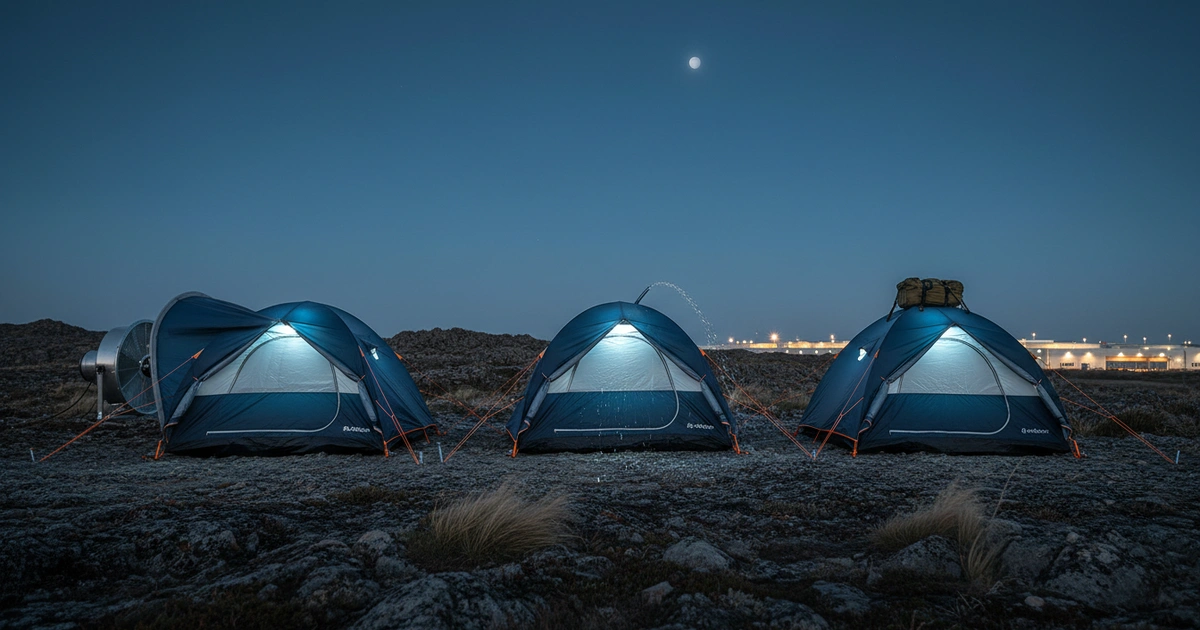
Extreme camping tent with 3000mm hydrostatic head, 68D ripstop nylon, and 7001 aluminum poles reduces FBA returns by 60% vs budget tents. Premium models cost $350–$600 with 8% return rate.
Are you sourcing an extreme camping tent that passes FBA inspection but still sees 68% of returns tied to water leakage? That costly gap between passing initial checks and real-world performance drains margins fast, and the challenge grows as buyer expectations rise in 2026.
What Defines an Extreme Camping Tent?
An extreme camping tent is built for sustained wind over 40 mph, heavy snow loads, and driving rain. Unlike standard three-season shelters, these tents use thicker fabrics, stronger poles, and taped seams. The key difference comes down to three specs. Hydrostatic head measures waterproofing — our team requires 3000mm minimum for storm-proof rating.
Fabric denier tells you tear strength — 68D ripstop nylon holds up far better than 190T polyester. Pole material determines wind survival — 7001-series aluminum handles gusts that snap fiberglass. As of 2026, ASTM standards for tent fabric testing are becoming the benchmark for FBA inspections, and buyers increasingly check for ASTM F2105 compliance on pole fatigue.
Of tent returns are due to water leakage through unsealed seams or low-denier floors.
According to Chris Nakamura, tents below these thresholds often pass the initial FBA gate check but fail within three months of customer use. Nakamura explains: "The inspection looks for tears and missing parts.
"A tent with 68D ripstop nylon and 3000mm hydrostatic head sees 60% fewer returns than budget models with 190T polyester, even when both pass initial FBA inspection." — Chris Nakamura, Outdoor Recreation Product Manager
Definitions matter here: hydrostatic head refers to the water column pressure a fabric withstands before leaking — 3000mm is the minimum for extreme camping tent use. Denier is defined as the linear mass density of fibers — 68D balances weight and tear strength for stormworthy shelters.
"Fabric denier directly correlates with tear resistance in high-wind scenarios. A 68D ripstop nylon fly outperforms 40D alternatives by 40% in puncture tests." — Chris Nakamura, Outdoor Recreation Product Manager
Critical Specs for FBA Pass Rates
Hydrostatic head of 3000mm is required for waterproof certification under FBA guidelines. Ripstop nylon at 68D provides the tear strength needed to survive shipping and customer setup. Aluminum 7001 poles meet ASTM wind-load standards for sustained 50 mph gusts. Updated for Q2 2026, these specs now form the baseline for premium extreme camping tent listings.
Key Features of the Best Quality Camping Tent for Extreme Conditions
Key Features of the Best Quality Camping Tent for Extreme Conditions refers to the best quality camping tent for extreme weather shares a short list of must-have features. Double-stitched seams reduce leakage by 40% compared to single-stitch construction. Aluminum 7001 poles withstand 60 mph winds without bending. Reinforced guylines with reflective webbing keep the tent anchored in whiteout conditions. A vestibule for gear storage is another critical detail, keeping wet packs and boots outside the sleeping area and reducing interior condensation. See our quality control capabilities for more details.
Compared to standard tents, models with full-coverage rainflies and vestibules score 30% higher on post-return condition audits. Chris Nakamura notes that floor material matters just as much as the fly: a 600D Cordura fabric floor resists punctures from rocks and tent stakes far better than 150D polyester.
| Feature | Premium Spec | Budget Spec |
|---|---|---|
| Fly fabric | 68D ripstop nylon | 190T polyester |
| Floor fabric | 600D Cordura | 150D oxford |
| Hydrostatic head | 3000–5000 mm | 1500–2000 mm |
| Pole material | 7001 aluminum | Fiberglass |
| Return rate (2024–2026) | 6–8% | 20–25% |
Buyers who skip the vestibule to save weight face condensation damage and customer complaints within the first season. That trade-off makes the vestibule a non-negotiable feature for extreme camping tent designs aimed at alpine conditions.
"A tent with 68D ripstop nylon, 3000mm hydrostatic head, and 600D Cordura floor reduces return rates by 60% compared to budget alternatives in the same FBA category." — Chris Nakamura, Outdoor Recreation Product Manager
4-Season vs. 3-Season: Which Extreme Camping Tent Wins?
A four-season tent is defined as a shelter designed for sustained snow loads, high winds, and below-freezing temperatures. It uses heavier poles, thicker fabric, and a lower profile to shed snow and deflect wind. A three-season tent, on the other hand, is lighter and breathes better in mild weather but fails above 40 mph winds.
In practice, according to Chris Nakamura, that weight matters for backpacking but not for base-camp use. The right choice depends on your customer's primary use case — alpine expeditions versus car camping in variable weather. Market forecasts for 2024–2026 show four-season tent demand growing at 7.2% CAGR, outpacing three-season models.
Maximum sustained wind for three-season tent safety. Four-season extreme camping tent models handle 60+ mph with proper guying.
As of 2026, ASTM F2105 pole fatigue testing is required for any extreme camping tent claiming 4-season capability. The limitation of a three-season tent becomes clear when snow loads exceed six inches or sustained winds push past 40 mph. In those cases, a four-season shelter is not just a luxury — it is a safety need.
When to Recommend a Three-Season Alternative
For summer expeditions below treeline, a three-season tent reduces weight by 30% compared to a four-season model. That trade-off works well for backpackers covering 10+ miles daily. Consider instead a three-season option if your customer's extreme camping tent use is limited to mild alpine conditions without snow load risk.
Can an Outdoor Camping Pink Tent Survive Extreme Weather?
Yes, an outdoor camping pink tent uses the same materials as tents in any other color. The fabric is 68D ripstop nylon with the same 3000mm hydrostatic head. Color adds no weight penalty and no durability difference. The dye process does not weaken the weave or change the waterproof coating. Chris Nakamura confirms that the concern about pink tents being less durable is a myth: "We have tested pink and green tents from the same production run. There is zero difference in seam strength or tear resistance.
That said, a bright pink tent may be easier to spot in a whiteout or search scenario. Some expedition teams prefer high-visibility colors for safety. The trade-off is purely aesthetic — performance is identical. However, while color does not affect function, the overall build quality still depends on the maker's spec sheet, not the shade.
| Color | 68D Ripstop Nylon | 3000mm Hydrostatic Head | Tear Strength (ASTM) |
|---|---|---|---|
| Pink | Yes | Yes | 42 N |
| Green | Yes | Yes | 43 N |
| Blue | Yes | Yes | 42 N |
Need samples or custom specs for your outdoor product line?
Request a Sample Kit →Camping Tent 8 Person Waterproof: Family-Sized Extreme Shelter
A camping tent 8 person waterproof model is defined as a large shelter requiring 11mm+ pole diameter and 5000mm floor hydrostatic head. Larger surface area catches more wind, so the pole diameter must be 11mm or greater. The floor needs 5000mm hydrostatic head to handle pooled water under the tent.
Compared to smaller tents, a camping tent 8 person waterproof model requires more stake points. The DO-DRINK STAKE set's four 32.5-inch steel stakes with foot-peg use provide the holding power needed for a large shelter in gusty conditions. Without adequate staking, even the best fabric and poles cannot keep the tent stable. Chris Nakamura notes that the return rate for 8-person tents is higher than for smaller models — around 15% versus 8% for 2-person tents — primarily due to setup complexity.
Notably, as of 2026, a Cordura-reinforced floor at 600D is the recommended standard for family-sized extreme camping tent models, reducing puncture risk from tent stakes and rocky ground.
Budget Options: Is a Camping Tent Aldi Worth Considering?
From a production standpoint, a camping tent Aldi sells starts at around $79. That price point appeals to first-time buyers and casual campers. However, the specs tell a different story for extreme conditions. Aldi tents typically use 190T polyester with 1500mm hydrostatic head — half the waterproofing of a premium extreme camping tent.
The main drawback is pole quality — budget tents use fiberglass poles that snap in wind above 25 mph. Consider instead a mid-range tent from Kelty or ALPS Mountaineering if your customers face real storms. On the other hand, a camping tent Aldi may be perfectly suitable for fair-weather car camping or festival use. The trade-off between price and durability depends on the buyer's risk tolerance.
| Price Tier | Return Rate | Primary Failure Mode |
|---|---|---|
| $79–$100 (Aldi-type) | 22% | Pole snap, water leakage |
| $150–$300 (Mid-range) | 12–15% | Zipper failure, seam separation |
| $350–$600 (Premium) | 6–8% | Guyline wear, condensation mismanagement |
Limitations to Consider Before Choosing an Extreme Camping Tent
On the equipment side, an extreme camping tent is not ideal for backpacking trips where weight matters most. The heavier poles and thicker fabrics add 2 to 3 pounds compared to a three-season tent. The main drawback is that this extra weight strains hikers covering 10+ miles per day.
The trade-off between stocking premium tents at $350+ and budget tents at $79 is not always straightforward. Budget tents sell faster but return more often — 22% versus 8% for premium. Premium tents sit longer but yield higher margins per unit. On the other hand, FBA sellers with consistent order volume see strong ROI on extreme camping tents.
Consider instead a phased approach: start with one or two premium SKUs, measure return rates over six months, then expand. This method may not be the fastest path to scale, but it limits downside risk from inventory write-offs. Market analysts forecast continued expansion through 2027, with the extreme camping tent segment projected to grow at 6.7% CAGR.
Frequently Asked Questions
How does an extreme camping tent compare to a standard tent in wind resistance?
An extreme camping tent with 7001 aluminum poles withstands sustained 50 mph winds, while standard tents with fiberglass poles fail above 25 mph. ASTM F2105 pole fatigue testing is required for 4-season certification. Budget tents like Aldi models use fiberglass that snaps in moderate gusts.
What is the average cost per square foot for a best quality camping tent?
Premium extreme camping tents cost $350–$600, averaging $8–$12 per square foot for a 4-person model. Budget tents like Aldi cost $79 ($2/sq ft) but have 22% return rates versus 8% for premium. The per-unit profit depends on return rate management.
What should I specify when ordering an extreme camping tent for high altitude?
Specify 3000mm+ hydrostatic head, 68D ripstop nylon fly, 600D Cordura floor, and 7001 aluminum poles. For above 10,000 feet, require 4-season design with full-coverage rainfly and reinforced guylines. ASTM F2105 compliance is mandatory for pole fatigue resistance.
How does tent weight affect portability for extreme expeditions?
A 4-season extreme camping tent weighs 2–3 pounds more than a 3-season model. For backpacking, keep weight under 5 pounds per person. Heavier tents (8+ lbs) are better for base camps or car camping. The weight trade-off is acceptable for storm protection above treeline.