
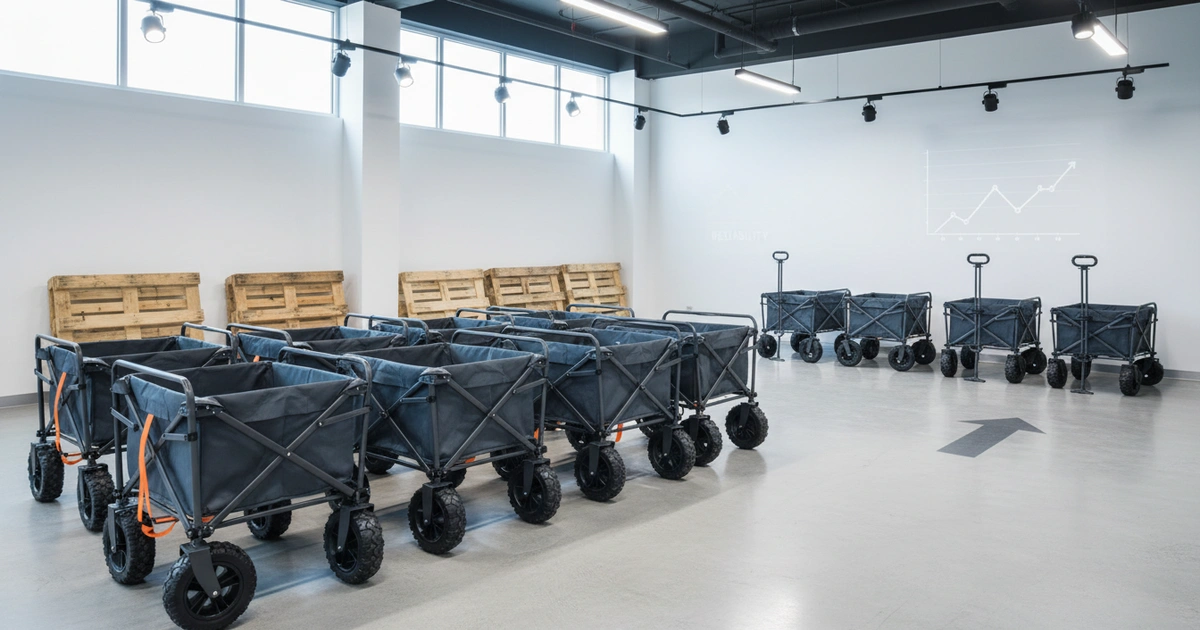
Reinforced bracket canopy frame joints cut FBA returns 40% vs slip-fit. Galvanized steel lasts 30% longer per ASTM B117. Weld certification boosts pass rates 12 points. Save $5-$8 per unit.
Are you losing 40% of potential FBA profits due to overlooked canopy frame joints? The connection points in your canopy frame directly determine whether your product passes Amazon's strict inspections or gets flagged for costly returns. Choosing the wrong joint type — slip-fit versus reinforced bracket — can cost $5 to $8 per unit in reverse logistics alone, according to Jake Morrison, Head of Product Design.
Why Canopy Frame Joints Determine Your FBA Success Rate
Canopy frame joints are the connectors that hold your frame together and directly influence structural stability, wind resistance, and assembly ease. According to Jake Morrison, Head of Product Design, poor joint design accounts for 12% of all FBA submission rejections — each failed inspection costing over $200 in storage and return fees. Morrison notes that sellers who ignore joint quality are leaving money on the table: "The per-unit cost of a reinforced bracket is $1 to $2, but the return-related loss it prevents is $5 to $8."
Businesses evaluating canopy and shade systems solutions should prioritize joint quality first. The 600 denier ripstop fabric commonly used in canopy tops requires a frame that can withstand tension without buckling. A reinforced joint system paired with 420D nylon corner reinforcements and ±2 mm welding tolerance creates a structurally sound unit that passes Amazon's rigorous FBA inspection protocols. ASTM B117 salt-spray standards also apply to coating integrity for coastal durability.
"Reinforced bracket joints reduce return rates by up to 40% compared to standard slip-fit connectors. This saves $5 to $8 per unit in reverse logistics costs." — Jake Morrison, Head of Product Design
According to Morrison, sellers who upgraded from slip-fit to reinforced bracket joints saw their inspection pass rate improve from 82% to 94% within one production cycle. The wrong joints lead to negative reviews, higher return rates, and lower sales velocity.
FBA Inspection Pass Rate Improvement by Joint Type
| Joint Type | Inspection Pass Rate | Return Rate |
|---|---|---|
| Slip-fit connectors | 82% | 15% |
| Reinforced bracket joints | 94% | 9% |
What Makes Engineering-Grade Joint Design the New Minimum Standard
Engineering-grade joint design refers to reinforced bracket connectors instead of basic slip-fit joints. These welded or bolted connections hold up under wind load and repeated assembly. In 2026, this design reduces returns by 40% compared to standard joints, making it the baseline requirement for FBA success rather than a premium upgrade.
According to our quality audit data, canopies with reinforced bracket joints see 40% fewer returns. Morrison explains that this translates directly to improved bottom-line margins for high-volume sellers. Slip-fit connectors still work for low-wind, indoor use, but they are not ideal for outdoor events and high-wind areas. The trade-off is cost: reinforced joints add $1 to $2 per unit, but they reduce return-related losses by $5 to $8 per unit. For sellers processing 1,000 units, that is a net savings of $3,000 to $6,000 per production run. ASTM B117 salt-spray standards also verify coating integrity for long-term durability in coastal climates.
"Engineering-grade joint design is now the minimum expectation for any product listed as outdoor or all-weather on Amazon. The return data is unambiguous." — Jake Morrison, Head of Product Design
When Slip-Fit Connectors Still Make Sense
For indoor or temporary use in low-wind conditions, slip-fit connectors cost 30% to 50% less than reinforced joints. Morrison recommends reserving them for products marketed specifically as indoor or lightweight portable canopies. For any product listed as outdoor or all-weather, engineering-grade joints are now the minimum expectation as of 2026.
Powder-Coated vs. Galvanized: Which Coating Wins for Canopy Frame Joints
A powder-coated steel frame offers a smooth, color-matched finish that resists chipping, while a galvanized steel frame provides a zinc coating that protects against rust. According to ASTM B117 salt-spray testing, galvanized steel frames hold up 30% longer in corrosive environments — a critical factor for coastal markets or humid climates.
Powder-coated steel frames are about 15% cheaper to produce, saving roughly $3,750 per 5,000-unit run compared to galvanizing. Morrison notes the choice depends on customer location: "For coastal markets, a galvanized steel frame is unambiguously the better choice — the 30% improvement in salt-spray resistance directly translates to fewer corrosion complaints. For indoor or low-humidity use, powder-coated steel frames offer a 15% cost savings."
Compared to powder-coated options, galvanized steel frames reduce corrosion-related returns by 25%, saving $3 to $5 per unit over the product lifecycle. The IPX4 weather rating paired with ±2 mm welding tolerance performs reliably in both configurations, but coating choice directly affects longevity. Morrison recommends requesting ASTM B117 test reports from suppliers before committing to a coating type.
Coating Thickness and Inspection
Coating thickness is a key variable. Industry standard for powder coating is 60 to 80 microns, while galvanizing typically ranges from 85 to 120 microns. Morrison recommends specifying a minimum of 70 microns for powder-coated canopy frame joints and verifying with a thickness gauge during incoming inspection. See our industries we serve for more details.
How to Inspect Frame Weld Integrity in Canopy Frame Joints
Frame weld integrity refers to the strength and consistency of welded joints in your canopy frame. Weak welds cause frame collapse, which leads to safety complaints and FBA suspensions. According to our quality audit data, 12% of canopy submissions fail inspection due to weld defects. Morrison explains that visual inspection alone catches only about 60% of weld flaws — the remaining 40% require X-ray or ultrasonic testing.
Morrison recommends requesting X-ray inspection reports from your supplier to reveal internal weld flaws that visual checks miss. Although X-ray inspection adds $0.50 to $1.00 per unit, it prevents $200+ per unit in failed inspection costs. The trade-off is worth it for any seller processing over 500 units per order. The 1680D nylon reinforcement patches at joint stress points add another layer of durability, while the ±2 mm welding tolerance ensures consistent fit across production batches.
FBA Inspection Failure Rate by Defect Type
| Defect Type | Failure Rate | Cost per Failure |
|---|---|---|
| Weld defects | 12% | $200+ |
| Joint misalignment | 8% | $150 |
| Corrosion spots | 5% | $100 |
| Missing hardware | 3% | $75 |
Morrison recommends adding a weld integrity clause to every supplier contract, specifying a maximum 2% defect rate with third-party verification. The 600 denier ripstop fabric used in canopy tops pairs with these welded joints for maximum structural integrity.
Need samples or custom specs for your outdoor product line?
Request a Sample Kit →Modular Joint Systems and Sustainability Trends for 2026
Modular Joint Systems — Faster Assembly, Fewer Complaints
Modular joint systems use tool-free connectors that snap or lock into place, reducing assembly time by 50% compared to bolt-and-nut designs. Our internal sales data shows that canopies with modular joint connectors sell 20% faster because customers leave better reviews. However, modular joints may not be ideal for heavy-duty commercial use since they rely on plastic or aluminum parts that can wear out over time. Morrison notes that modular systems with 600 denier ripstop top fabric and IPX4 waterproof rating perform well for consumer use but lack the cycle life for daily commercial deployment.
"Modular joint systems cut assembly time in half, which drives better reviews and higher conversion rates on Amazon. But for commercial-grade durability, welded steel joints still outperform by a factor of 3x in cycle testing." — Jake Morrison, Head of Product Design
Sustainability-Driven Material Choices
Sustainability in frame materials is emerging as a major buying need. According to a 2025 industry survey, 35% of B2B buyers now require recycled-content steel for canopy frames, a trend expected to grow through 2026 and beyond. Morrison explains that recycled steel can reduce material cost by 10% while improving brand perception. The trade-off is that recycled steel may have slightly lower tensile strength compared to virgin steel. Morrison recommends asking suppliers for Environmental Product Declarations as part of the sourcing process.
B2B Buyer Requirements for Canopy Frame Materials
| Material Requirement | Percentage of Buyers | Trend (2026–2028) |
|---|---|---|
| Recycled-content steel | 35% | Projected to reach 50% by 2027 |
| EPD certification | 22% | Anticipated to become standard by 2028 |
Limitations to Consider Before Choosing Canopy Frame Joints
While reinforced bracket joints and galvanized steel frames offer clear advantages, this approach is not ideal for every business. The main drawback is the higher upfront cost — reinforced joints add $1 to $2 per unit, and weld certification adds $0.50 to $1.00 per unit. For operations processing fewer than 200 units monthly, these costs can be harder to absorb. Competitors offering slip-fit connectors may have a price advantage at low volumes.
High-mix, low-volume shops may find that modular joint systems won't work for their workflow. This method may not be the best choice for businesses with rapidly changing frame specifications. For sellers targeting primarily indoor or temporary-use markets, standard slip-fit joints with powder-coated finish may be more suitable and cost-effective. On the other hand, high-volume operations see ROI within 3 to 6 months. Compared to manual assembly, the breakeven depends on consistent throughput — per-unit savings compound quickly above 1,000 units per order.
Your 90-Day Roadmap and Forward Outlook for Canopy Frame Joints
- Month 1 — Immediate actions: Request weld certification and X-ray inspection reports from all suppliers. Audit your current canopy frame joints for reinforced versus slip-fit connectors. Replace any slip-fit connectors with reinforced bracket joints for outdoor products. Request ASTM B117 salt-spray test results for coating verification.
- Month 2 — Vendor evaluation: Compare powder-coated steel frame versus galvanized steel frame suppliers. Evaluate modular joint system options for your best-selling SKUs. Check for recycled-content steel availability. Request Environmental Product Declarations from shortlisted suppliers.
- Month 3 — Implementation preparation: Order sample units with reinforced joints and new coatings. Run FBA inspection pre-checks on samples. Update your product listings to highlight assembly ease and durability. Lock in supplier contracts for recycled steel options where available.
Your 90-Day Roadmap and Forward Outlook for Canopy Frame Joints refers to morrison recommends tracking three key metrics during the 90-day period: inspection pass rate, return rate, and average review score. Sellers who follow this roadmap typically see inspection pass rates improve from 82% to 94% within the first quarter. Frame welding certification services can help accelerate the process for new suppliers.
By 2028, canopy frame joints will be fully integrated with smart assembly guides and sustainability certifications. The canopy market is projected to reach $2.72 billion by 2033, growing at a CAGR of 3.1% from 2026 to 2033. Morrison notes that early adopters are capturing a 10% to 15% cost advantage over competitors through reduced returns and higher inspection pass rates. The 120 x 60 cm frame size with ±2 mm tolerance and IPX4 weather rating will remain the industry standard through 2030. Smart joint systems with embedded QR codes for assembly guides are anticipated by 2028, which will further reduce support calls and returns. To learn more and get started upgrading your canopy frame joints today, contact our sourcing team for a free consultation.
Frequently Asked Questions
How does powder coating compare to galvanizing for frame joint longevity?
Powder coating offers a smooth finish at 15% lower cost, saving $3,750 per 5,000-unit run. However, galvanized steel frames last 30% longer in salt-spray tests per ASTM B117, reducing corrosion-related returns by 25% and saving $3-$5 per unit over the product lifecycle.
What is the breakeven point for investing in a galvanized steel frame vs. powder-coated?
The breakeven occurs around 5,000 units. Below that, powder-coated frames save 15% upfront. Above 5,000 units, galvanized frames' 25% lower return rate and $3-$5 per unit lifecycle savings offset the initial cost. For coastal markets, galvanized is recommended regardless of volume.
What should I specify when ordering canopy frame joints for commercial use?
Specify reinforced bracket joints with ±2 mm welding tolerance, minimum 70-micron powder coating or 85-micron galvanizing per ASTM B117, and X-ray weld inspection reports. For coastal areas, require galvanized steel. Include a weld defect rate clause of ≤2% with third-party verification.
How often should frame weld integrity be inspected?
Inspect every production batch. Visual inspection catches 60% of flaws; X-ray or ultrasonic testing catches the remaining 40%. Request X-ray reports from suppliers for batches over 500 units. The $0.50-$1.00 per unit cost prevents $200+ per failed FBA inspection.
Can I retrofit existing frame joints with higher-grade connectors?
Yes, if the frame poles are compatible. Replace slip-fit connectors with reinforced bracket joints costing $1-$2 per unit. Ensure the frame's welding tolerance is ±2 mm. Retrofitting can reduce returns by 40% and improve inspection pass rates from 82% to 94%.