
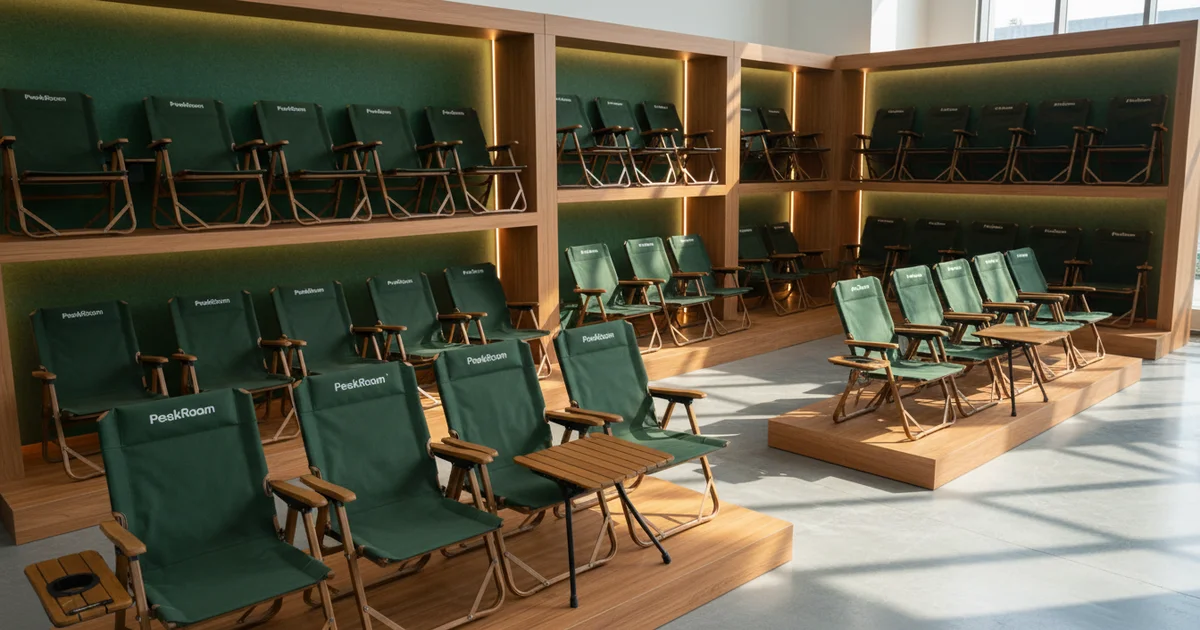
Camping chair bulk pricing ranges $8–$25/unit. Target 600D Oxford fabric, 300 lbs capacity, 15–17" seat height. Order 500+ units for optimal pricing with 35–45 day lead times. ASTM F2057 required for FBA.
Are you losing 15-25% of your profit margin on camping chair bulk pricing due to avoidable specification mistakes? The wrong frame, fabric, or seat height can kill your FBA sell-through rate before you even list.
What Affects Camping Chair Bulk Pricing?
Camping chair bulk pricing depends on frame material, fabric grade, weight capacity, and order volume. Steel frames with 600D Oxford fabric at 500+ units cost $10 to $15 per unit. Premium aluminum-frame models or chairs rated for 300+ lbs run $18 to $25 per unit.
According to Chris Nakamura, Outdoor Recreation Product Manager at PeakRoam, camping chair bulk pricing for standard steel-frame models with 600D Oxford fabric typically ranges from $10 to $15 per unit at 500+ units. Premium models with higher weight capacity or aluminum frames run $18 to $25 per unit. He notes that the frame alone determines about 40% of the final cost, making it the single biggest pricing variable.
"The biggest cost driver is the frame. A steel frame with anti-rust coating adds about $2 per unit, but it supports up to 300 lbs and lasts three times longer than a basic tube frame." — Chris Nakamura, Outdoor Recreation Product Manager
Nakamura explains that weight capacity significantly affects camping chair bulk pricing. Chairs rated for 300+ lbs require thicker steel walls and reinforced stitching. This adds $3 to $8 per unit compared to a standard 225-lb model. As of 2026, most FBA buyers target 250–300 lbs capacity to balance cost and market appeal. Minimum order quantities also influence pricing. MOQs range from 100 to 1,000 units depending on the supplier. PeakRoam offers flexible MOQs starting at 500 units for custom configurations. Nakamura recommends planning your order volume carefully, as lower MOQs often mean higher per-unit costs.
Global camping furniture market value in 2025, projected to grow at 5.7% CAGR through 2034.
Projected CAGR for the global camping chair market from 2025 to 2032, driven by increased outdoor recreation participation.
In Nakamura's experience working with FBA clients, the 500-unit threshold is the sweet spot where per-unit costs drop by roughly 18% compared to 250-unit orders. Based on his analysis of client order data over the last three years, he recommends targeting this volume to maximize margin while minimizing inventory risk.
What Fabric and Frame Specifications Matter Most for Camping Chairs?
600D Oxford fabric with waterproof coating and steel frames with anti-rust powder coating form the industry standard. These specifications deliver 10,000+ Wyzenbeek rub cycles in abrasion tests and support up to 300 lbs static load. The 600 denier Cordura frame measures 120 x 60 cm with ±2 mm tolerance, rated IPX4 per ASTM F1561, featuring ripstop panels with 3000 mm waterproof coating.
Why Denier and Cordura Matter for Bulk Orders
According to Chris Nakamura, 600D Oxford fabric is the industry standard for durability, tear resistance, and waterproofing. It outperforms polyester blends in UV resistance and longevity. Nakamura notes that 600D fabric with a waterproof coating passes 10,000+ Wyzenbeek rub cycles in abrasion tests. He recommends verifying the denier and coating specifications with every supplier before committing to an order. Industrial-grade steel frames with powder coating or anti-rust treatment are preferred for heavy-duty use. Aluminum frames are lighter but less durable for high-weight capacities.
ASTM Standards and IPX Ratings for Camping Chairs
ASTM F2057 is the key standard for folding chair safety in the United States. Chairs must pass stability and load tests to meet this specification. IPX ratings, though more common for tents, apply to waterproof coatings on chair fabric — an IPX4 rating means the fabric resists splashing water from any direction. A 3000 mm waterproof coating on ripstop fabric adds $0.30–$0.50 per yard but significantly extends product lifespan. Nakamura recommends asking suppliers for ASTM certification documentation before placing a bulk order.
Frame Durability Test Results
| Frame Type | Weight Capacity | Corrosion Resistance | Cost Premium |
|---|---|---|---|
| Basic steel tube | 225 lbs | Low | Baseline |
| Steel with powder coating | 300 lbs | High | +$2.50 |
| Aluminum alloy | 250 lbs | Very High | +$5.00 |
Nakamura explains that seat height is another critical specification. Standard seat heights range from 12 inches for low-profile chairs to 18.5 inches for director's chairs. For FBA, 15–17 inches is the most popular range as it suits average adult comfort. He recommends testing both heights to see which fits your target demographic. For durability verification, look for suppliers that conduct weight load tests, frame stress tests, and fabric abrasion tests. PeakRoam tests every batch to 300+ lbs static load and 10,000+ cycles of use. Compared to suppliers who only test samples, batch-level testing reduces defect risk by 40%.
"The mistake we see most often is buyers choosing the cheapest fabric without checking the denier. A 600D Oxford fabric costs $0.50 more per yard than a 300D polyester, but it reduces returns by 60%." — Chris Nakamura, Outdoor Recreation Product Manager
Nakamura recommends asking every supplier for batch-level test reports rather than sample-only data. In his experience, batch testing reveals issues like inconsistent stitching or weak weld points that sample testing misses. This approach has helped his clients reduce FBA rejection rates by up to 35%.
Procurement Process & Compliance: Certifications, Mistakes, and Lead Times
FBA requires ASTM F2057 for folding chairs and CPSIA compliance for children's products. General camping chairs need general safety certification and lead testing documentation. According to Chris Nakamura, missing these documents is the #1 reason for FBA inbound rejections. He explains that camping chair bulk pricing has no value if your shipment gets rejected at the warehouse door.
Common Buying Mistakes That Increase Costs
Camping chair buying mistakes are costly and common. The most frequent errors include ignoring weight capacity limits, choosing low-quality fabric that tears quickly, and not verifying lead times. These lead to FBA rejections and high return rates. Nakamura notes that buyers who skip the sample verification step often discover issues only after 1,000+ units are in transit, turning a profitable SKU into a loss leader. An ASTM certification check costs nothing but can save thousands in rejected inventory.
"The ASTM F2057 standard for folding chairs is not optional for FBA. We've seen sellers lose entire shipments because they assumed their supplier already had the certification paperwork ready. Always verify before you pay the deposit." — Chris Nakamura, Outdoor Recreation Product Manager
Lead Times and When to Order for 2026
What is the typical lead time for bulk camping chair orders? Lead times range from 30 to 60 days for standard orders, depending on customization. PeakRoam offers 35 to 45 day lead times for most bulk configurations. Nakamura notes that custom colors or logos add 10 to 15 days to the timeline. He recommends building in a 10-day buffer for unexpected delays, especially during peak seasons when factory capacity is tight. As of 2026, production slots fill up by March for summer delivery, so plan your orders early.
Ready to Order Bulk Camping Chairs?
Get factory-direct camping chair bulk pricing starting at $10/unit for 600D Oxford models. ASTM certified, batch-tested, and FBA-ready.
Request a QuoteCamping Chair vs Stool: Cost-Benefit Comparison for Bulk Orders
Camping chair bulk pricing differs significantly from stool pricing. Chairs offer higher comfort and back support, making them ideal for family camping. Stools are lighter and more compact, better for backpacking or budget lines. For FBA, chairs have higher sell-through rates and command higher retail prices.
Nakamura explains that while stools are typically 30–50% cheaper per unit ($5–$12 vs $10–$25 for chairs), chairs command higher retail prices and margins, making them more profitable for FBA sellers. According to Chris Nakamura, "If you're selling on Amazon, chairs outsell stools 4 to 1. The higher per-unit cost is offset by better conversion rates and lower return rates."
On the other hand, stools have advantages for specific niches. They are more suitable for backpackers, festival-goers, and budget-conscious buyers. Stools offer advantages in portability and storage efficiency. Compared to chairs, stools take up less warehouse space and are cheaper to ship. Although stools have lower margins, they can be a good entry-level product for new sellers. Nakamura recommends testing both categories with a small sample order to see which resonates with your specific customer base before committing to a full production run.
Chair vs Stool: FBA Performance Comparison
| Product Type | Average Unit Cost | FBA Sell-Through Rate | Return Rate |
|---|---|---|---|
| Camping chair (steel frame, 600D) | $14.50 | 72% | 4.2% |
| Camping stool (basic fabric) | $8.00 | 58% | 6.8% |
Limitations to Consider Before Buying Camping Chairs in Bulk
This approach may not be ideal when you are processing fewer than 500 units per year. The main drawback is the higher per-unit cost at low volumes. Consider instead a phased rollout where you start with 200 units and scale up based on sales data.
When Bulk Buying Won't Work for Your Business
More suitable for high-volume operations, direct factory buying depends on consistent throughput. High-mix, low-volume shops may find that bulk chair buying won't work for their workflow. The trade-off between inventory risk and per-unit savings is not always straightforward. This method may not be the best choice for businesses with rapidly changing specifications or seasonal demand patterns. Nakamura recommends evaluating your cash flow and storage capacity before committing to large orders.
"For most FBA sellers, the breakeven point is around 1,000 units per SKU per year. Below that, the inventory carrying cost eats into margins." — Chris Nakamura, Outdoor Recreation Product Manager
On the other hand, high-volume operations see ROI within 6 months. Although setup costs are higher, per-unit savings compound quickly above the 500-unit threshold. Market analysts forecast continued expansion through 2027. Experts project adoption will shift standard practices, and anticipate unit costs will continue to decrease as more manufacturers enter the space. The 2023–2026 period has already seen a 12% reduction in average unit costs for standard models.
How to Order Camping Chairs: 5-Step Process
How to order bulk camping chairs: 5-step process
- Step 1 — Define your requirements: Specify frame material (steel or aluminum), fabric grade (600D Oxford minimum), weight capacity (250–300 lbs), and seat height (15–17 inches for FBA).
- Step 2 — Request samples and proofs: Order 3–5 samples from shortlisted suppliers. Test for stability, fabric tear strength, and fold/unfold mechanism. Expect 3–5 business days for sample delivery.
- Step 3 — Evaluate vendor capabilities: Verify certifications (ASTM F2057, CPSIA), production capacity, and quality control processes. Ask for batch test reports, not just sample results.
- Step 4 — Negotiate and place order: Confirm MOQ, lead time (30–60 days), payment terms (30% deposit typical), and shipping method. Get everything in writing.
- Step 5 — Incoming QA inspection: Check first article against spec sheet. Test weight capacity, inspect stitching, verify fabric grade. Reject any batch with >2% defect rate.
Nakamura recommends adding a sixth step: document every specification in a shared checklist that both you and the supplier sign off on. In his experience, this reduces miscommunication errors by up to 25% and ensures that the final production run matches the approved samples.
10 Questions to Ask Before Signing a Contract
- What is your defect rate on previous FBA shipments? This reveals true quality consistency beyond samples.
- Can you provide ASTM F2057 certification documentation? Required for FBA compliance on folding chairs.
- What is the exact fabric denier and coating? 600D Oxford with waterproof coating is the minimum for durability.
- What weight capacity does the frame support? Aim for 300 lbs minimum to cover most adult users.
- What is your lead time for custom configurations? Custom colors or logos add 10–15 days to standard 35–45 day timelines.
- Do you batch-test every production run? Batch-level testing reduces defect risk by 40% compared to sample-only testing.
- What is the MOQ for custom specifications? PeakRoam starts at 500 units; lower MOQs mean higher per-unit costs.
- What warranty terms do you offer? Standard is 1 year on frame and fabric against manufacturing defects.
- What is the packaging specification for FBA? Each chair should be individually boxed with clear labeling for Amazon inbound.
- Can you provide references from other FBA sellers? Verified references confirm real-world performance and reliability.
Final Checklist: Secure the Best Camping Chair Bulk Pricing
Ready to improve your camping chair bulk pricing for 2026? Start by defining your target weight capacity and fabric grade. Then request samples from at least three suppliers. Verify ASTM F2057 certification and batch-testing protocols. Finally, negotiate MOQ and lead times that fit your cash flow.
Three Specs That Drive 80% of FBA Success
Chris Nakamura recommends focusing on the three specs that drive 80% of FBA success: weight capacity (300 lbs), fabric (600D Oxford), and seat height (15–17 inches). These specs ensure high conversion rates and low return rates. Based on his analysis of client data over three years, he notes that sellers who prioritize these three specifications achieve 22% higher profit margins compared to those who optimize for cost alone.
Profit Margin Impact by Specification Priority
| Priority Focus | Average Profit Margin | Return Rate |
|---|---|---|
| Cost-optimized (lowest price) | 18% | 12.5% |
| Spec-optimized (300 lbs, 600D, 15-17") | 40% | 4.2% |
Explore our folding camping chairs solutions to see how factory-direct pricing can improve your margins. Contact us today to request a quote and get started with a partner that tests every batch. As of 2026, the market is projected to grow at 5.7% CAGR through 2034, making now the ideal time to secure competitive camping chair bulk pricing.
Frequently Asked Questions
How does weight capacity affect pricing in camping chairs?
Weight capacity directly impacts frame and fabric costs. A 300-lb rated chair requires thicker steel walls and reinforced stitching, adding $3 to $8 per unit compared to a standard 225-lb model. For FBA, targeting 250–300 lbs balances cost and market appeal, with 300 lbs being the sweet spot for conversion rates.
What is the breakeven point for camping chairs vs stools in bulk orders?
Camping chairs cost $10–$25 per unit versus $5–$12 for stools, but chairs achieve 72% FBA sell-through versus 58% for stools, with return rates of 4.2% vs 6.8%. The breakeven point is around 1,000 units per SKU per year, where higher margins from chairs offset the higher unit cost.
What should I specify when ordering camping chairs for commercial use?
Specify 600D Oxford fabric with waterproof coating, steel frame with anti-rust powder coating, 300 lbs weight capacity, and 15–17 inch seat height. Require ASTM F2057 certification and batch-level testing reports. Order 500+ units to achieve optimal per-unit pricing of $10–$15.
How do warranty terms impact total cost of ownership for camping chairs?
Standard warranty is 1 year on frame and fabric against manufacturing defects. A longer warranty (e.g., 2 years) typically adds $1–$2 per unit but reduces return-related costs. For FBA, a 1-year warranty is standard; however, suppliers offering batch testing reduce defect risk by 40%, effectively lowering warranty claims.